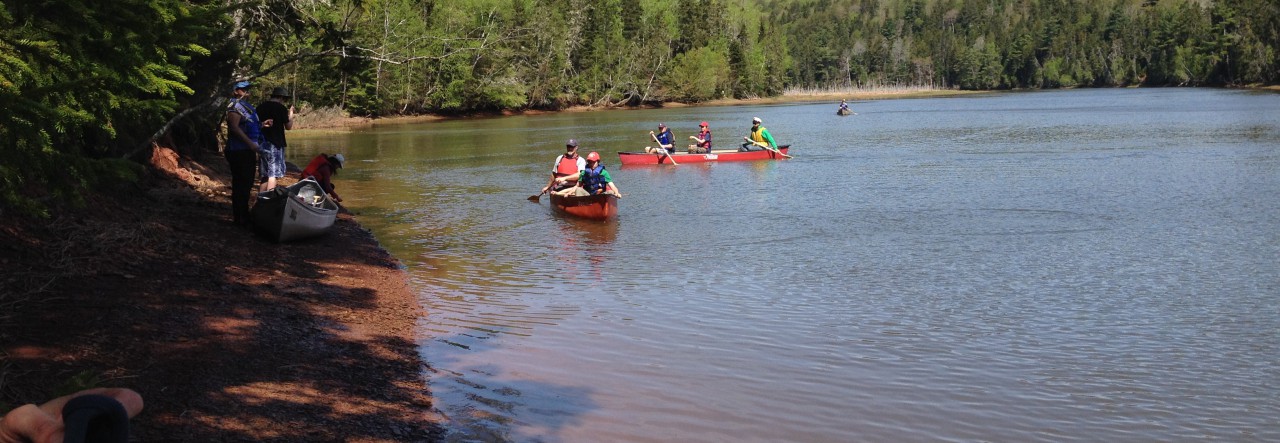
Members of the Coalition

Members of the Coalition for the Protection of PEI Water to-date include:

Citizens’ Alliance of PEI

Atlantic Canada Chapter of Sierra Club

Cascumpec Watershed Association

Cooper Institute

Cornwall & Area Watershed Group

Council of Canadians

Don’t Frack PEI

Ellen’s Creek Watershed Group

Environmental Coalition of PEI

Friends of Covehead-Brackley Bay Watershed

Green Party PEI

Hunter-Clyde Watershed Group

National Farmers Union, District 1, Region 1

New Democratic Party of PEI

Pesticide Free PEI

Save Our Seas and Shores PEI

South Shore Watershed Association  (Tryon River, Westmoreland River, DeSable River, Augustine Cove and Cape Traverse, and Seven Mile Bay Watershed Associations)

Winter River – Tracadie Bay Watershed Assoc.

Over 200 individual members
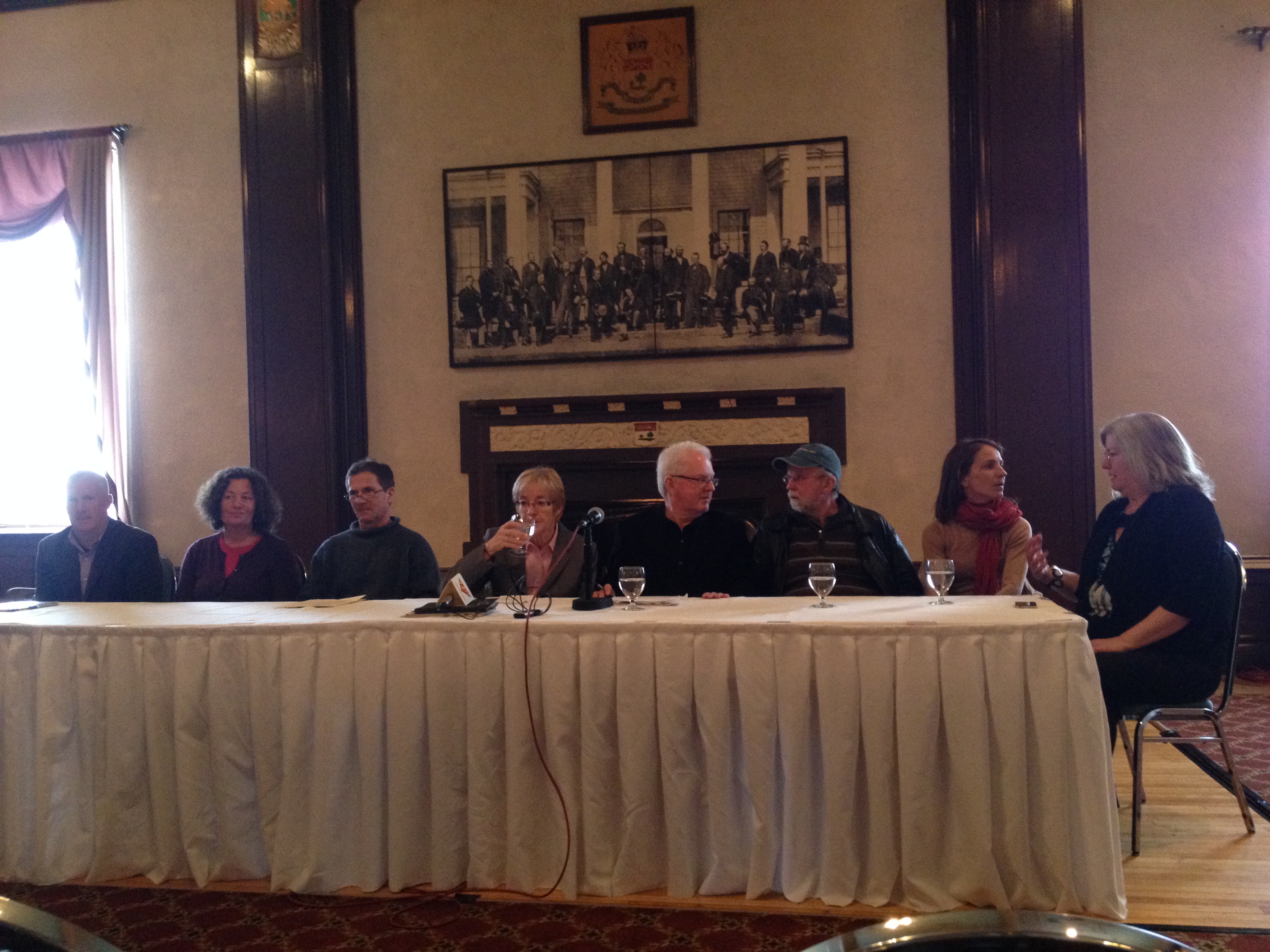
press conference with Maude Barlow, the Council of Canadians, and the CoalitionAnd the statement that will be read by Boyd Allen today at the press conference from the Coalition (with thanks for sharing that):

By mid-January, 2014, PEI residents had some time to examine the proposal to lift the moratorium on high capacity irrigation wells brought forward to Government by the processing industry and the PEI Potato Board. This became the catalyst for a groundswell of thoughtful and informed opinions which flooded an array of media across the island.

The Citizens’ Alliance of PEI sent out invitations island-wide to engage people and organizations to meet and address this issue. From this, and subsequent meetings, The Coalition for the Protection of PEI Water emerged. Our organization is composed of concerned citizens and includes The Citizens’ Alliance of PEI, the PEI Watershed Alliance, Pesticide PEI, District 1, Region 1 of the National Farmers Union, Green Party of PEI, Environmental Coalition of PEI, Don’t Frack PEI, Cooper Institute, Several Watershed Groups, Council of Canadians, New Democratic Party of PEI, Sierra Club PEI, Save Our Seas and Shores. Among the coalition members are a number of physical, natural, and social scientists. The aim of this community-based organization is to share resources, skills and time to offer an informed, unified public voice in a process in which this voice traditionally has limited access.

The Coalition for the Protection of PEI Water strongly opposes any lifting of the moratorium on new high capacity irrigation wells.

We feel that the monitoring and enforcement component attached to the existing high capacity wells is inadequate.

We feel that the data compiled to support the lifting of the moratorium is incomplete.

We recommend an opportunity for peer review of the water extraction policy, the data and the models used to support it.

We recommend the establishment and funding of a transparent, inclusive public consultation process to examine all aspects of this policy.

We recommend the establishment of a multi-disciplinary commission to develop a comprehensive, integrated water policy for PEI.

The Coalition for the Protection of PEI Water will be presenting our position on maintaining the moratorium on high capacity wells to the standing Committee of Agriculture, Environment, Energy and Forestry 1:30 pm tomorrow, Thursday 26 February at the Coles Building.

February 26th, 2014

Regarding water issues and especially the high capacity wells, there are three events happening in the next two days that you are most welcome to attend:

  • the first is a press conference with Maude Barlow, the Council of Canadians, and the Coalition today, Wednesday, February 26th, at 11AM, at the Rodd Charlottetown (Provinces Room).  Corner of Kent and Pownal in Charlottetown.  There will be people there from many of the groups on the Coalition for the Protection of PEI Water. Boyd Allen will be representing the Coalition (see statement, below), and Cindy Richards on behalf of the Citizens’ Alliance.
  • Maude Barlow (Council of Canadians Chair, and author of many books), biologist Daryl Guignion and organic farmer Reg Phalen are part of a forum on water issues tonight, 7PM, Rodd Charlottetown. It’s co-sponsored by the Council of Canadians and the Coalition for the Protection of PEI Water, and emceed by Catherine O’Brien.  Definitely be a great public event you can tell others about, if they don’t know about it already.  https://www.facebook.com/events/394497057360643/?ref=2&ref_dashboard_filter=upcoming
  • Thursday afternoon (1:30PM) is a government standing committee meeting, where the Coalition for the Protection of PEI Water will be presenting a submission. Catherine O’Brien and Boyd Allen will be representing the Coalition.  **People in the Gallery (the seating at one side of the room) really make an impact on the Committee as far as gauging public interest**, if you can be there at all, even for ten or 15 minutes.   It is in the Pope Room of the Coles Building. The Coles Building is the pretty old block building to the other side of Province House (Confed Centre on the other side).   You go up the stairs to the main floor and check in with a concierge, and go down the hall to the Pope Room, where there are chairs for the “gallery” (spectators).  We will likely be speaking at about 1:45-2PM or so for a half hour or so. (People can come and go as their schedules allow.)

And, if you live in the Brackley area, tonight is the public meeting with Minister Vessey about plans to move the “government garage” from Riverside Drive by the Civic Centre and the Wendy’s/Tim’s to a piece of land that was a 100-acre farm just outside Charlottetown city limits on Route 15.  If you want to decide for yourself if this is a good use of government money and farmland, I believe it is at the Brackley Community Centre tonight.


February 24th, 2014

More about related to calculating “recharge of aquifiers”, using swimming pools as a visible analogy.
http://www.theguardian.pe.ca/Opinion/Letter-to-editor/2014-02-20/article-3622240/Leave-pools-out-of-water-debate/1

Leave pools out of water debate
The Guardian letter to the editor
Published on February 20, 2014 

Editor:
Like most regular readers, I have been following with interest, the numerous articles and letters in The Guardian on the issue of deep-water wells. In the headline article of Fridayʼs (February 14) paper, “ No decision made on deep-water wells: Sherry,” there was an assertion attributed to Mr. Bruce Raymond (manager of watershed and subdivision planning for the province), that is worthy of pause and re-examination. Mr. Raymond is quoted, saying, that the rate at which P.E.Iʼs groundwater is replenished every year is “equal to 154 Olympic-sized swimming pools for every square inch of the Island”.
According to Wikipedia, an Olympic-sized swimming pool contains 2.5 million litres of water, with a volume of 88,0000 cubic feet. It is easy to determine that one cubic foot of water would be 144 feet in height on a single square inch of P.E.I. soil. It follows that 88,000 cubic feet would be 2,400 miles high! That is for a single Olympic-sized swimming pool. For 154 pools, this tower of water would reach an amazing 369,600 miles in height, which is 1.5 times further away than the moon. Hmm. That would be one wicked replenishment rate.
According to Island information, however, “the average yearly rainfall is 1125.8 mm and the average yearly snowfall is 318.2 mm” on Prince Edward Island. That translates to approximately 1.5 meters (or 5 feet) of precipitation per year.
Comparing 369,600 miles to 5 feet, we can determine that the Olympic-sized pool reference is out by a factor in excess of 390 million. Clearly, either Mr. Raymond was misunderstood or he misinterpreted the data. Either way, it seems clear — it would be better to simply disregard any future reference to swimming pools.
Mel Gallant,
Charlottetown

February 22nd, 2014

Despite the imperative headline given to it (it was different in the peicanada.com website as “Deep water wells risk turning ocean into salt water desert”), it is an interesting letter to contemplate:

Man should not drill into aquifer
Published on February 20, 2014 in The Guardian

Editor:
On the basis of groundwater, the sandstone of P.E.I. is considered to be composed of two zones: an upper zone, highly fractured having significant near-vertical fracturing and a lower zone, below about 35 metres, much less fractured and having few near-vertical fractures. Below the first aquitard layer the lower zone is known as the confined aquifer. An aquitard is a material like claystone and siltstone that has low permeability but transmits water at low flow rates.
The water flow in the confined aquifer is referred to as the ʻdeeper circulationʼ and is on a regional scale and not restricted to watersheds. Once the confined aquifer enters under the ocean it is called the confined submarine groundwater discharge (CSGD) aquifer. This deeper circulation through the CSGD affects directly the productivity of the ocean and has been and is being impacted in P.E.I. by human activities of the surface.
The proper jurisdiction of the confined aquifer should be the Department of Fisheries and Oceans.
The CSGD aquifer is driven by the deeper circulation of the confined aquifer on land, gravity in the end. Man should not be drilling into the confined aquifer on land and withdrawing its water. Municipal wells are not excluded. The deep water wells that have been drilled are removing water from the deep circulation and are reducing the productivity of the fisheries. We are killing the ocean. Existing deep water wells should be sealed off at where they puncture the confined aquifer. The confined aquifer should be sealed off and truly deep geological exploration wells should have casings to 300 meters at least.
We should thank the persons who had the wisdom to place a moratorium on deep water drilling in 2003. We must restore the deeper circulation; otherwise, we run the risk of turning the ocean into a saltwater desert.
Tony Lloyd,
Mount Stewart

Comments on the PEI Extraction Policy presentation

The second is enclosed in this e-mail and what was read aloud at the last meeting: comments on the PEI Extraction Policy presentation written by Dr. Scott Rice-Snow, a hydrologist at Ball State University who was an adjunct professor with the Institute of Island Studies and lived on PEI for half of last year.

<<
I've had the chance to look at some of the web postings about the high-capacity well proposal, including the Ministry of Environment PowerPoint. The 'science' presented so far is certainly limited, and I can't claim to know all regulations in place for PEI groundwater that might be escaping coverage, Here are some thoughts:

The island-wide average 7%-used statistic seems to be getting most of the press, but is basically useless for evaluation of the water extraction conditions in any one part of the island, and therefore for setting water policy for the whole. Evaluation should be at least focused to the particular watershed. The Environment presentation makes this clear, and shows that particular watersheds on the island are already overstressed.

The criteria given for water extraction, that would presumably be applied if the moratorium is lifted, are focused on maintenance of the majority of local stream base flow. They don't address other concerns, such as change in concentration of pollutants in groundwater, lowering of water levels in nearby wells, and coastal salt water intrusion in aquifers. If the island decides to allow high-capacity extraction proposals, evaluated case-by-case, it would be important to broaden the bases for refusal.

The argument "It's all (mostly) just going right back into the ground anyway" won't have any validity if water is being transported from one watershed to another. (This adds to concerns about the quality of the returned water.) Transporting irrigation water across watersheds might become a lot more common as an answer denial of local extraction permits.

Any big well will create a 'cone of depression' in the water table surface that could lower water levels in nearby wells, and possibly shift directions of groundwater (and pollutant) flows in the surrounding area. These effects should be simulated, and open to public comment, prior to a permit.

If a proposed well is in a headwaters area of a basin, it's especially important to ask for a water budget for only that part of the watershed. Even if the watershed-wide water balance fits criteria, the smaller area's groundwater levels could lower considerably, and portions of nearby streams go dry. A big well near a watershed divide can draw in groundwater from adjacent watersheds, reversing previous directions of groundwater flow. If a proposed well is far downstream, near salt water, then local salt water intrusion into the aquifer is a key concern.

Of course, the variety of problems that could occur in specific locations might be brushed over at this stage of the debate, but they do bear on what protections should be in place before a ban is lifted, and in considering the cost/benefits of lifting the ban at all.

Water resources for PEI

A Conservation Strategy for Atlantic Salmon in P.E.I.
http://atlanticsalmonfederation.org/pei/2009peireport.html

With this note: There is reference in this report to the impact of irrigation and the importance of headwaters for spawning of salmon but would apply also to brook trout.
———-

Resources from the Watershed Alliance’s Workshop on Groundwater Extraction, November 30, 2013

The Groundwater Extraction Workshop held by the PEI Watershed Alliance on November 30, 2014 allowed various groups to put forward their research and their views on groundwater extraction on Prince Edward Island. The presentations are available through the PE Watershed Alliance website:

The Water Beneath Our Feet: Understanding the Groundwater Resource (Kerry MacQuarrie) http://peiwatershedalliance.org/web/wp-content/uploads/2012/04/PEI_watershed_alliance_presentation_Nov30.pdf

A modeling tool for assessing the impacts of groundwater extractions on stream flow in PEI  (Yefang Jiang)http://peiwatershedalliance.org/web/wp-content/uploads/2012/04/modeling-impacts-by-GW-extractions-in-PEI1.pdf

Water Extraction Policy for PEI (Department of Environment, Labour & Justice) http://peiwatershedalliance.org/web/wp-content/uploads/2012/04/PEI-Water-Extraction-Policy-G-Somers-Nov-30-2013.pdf

Irrigation on PEI: The On Farm Perspective ( Innovative Farms Group) http://peiwatershedalliance.org/web/wp-content/uploads/2012/04/Irrigation-On-PEI-The-on-farm-perspective-1.0.pdf

What Supplemental Irrigation can do for the PEI Potato Industry (Cavendish Farms and the PEI Potato Board) http://peiwatershedalliance.org/web/wp-content/uploads/2012/04/cavendishHCwells2013PPTVIEW.pdf

Why Fish Need Water – Cool, Clean, Abundant Water (Daryl Guignion) http://peiwatershedalliance.org/web/wp-content/uploads/2012/04/Why-fish-need-water-November-30-2013.pdf

Understanding the Potential Impacts of Water Abstractions on Stream Ecosystems of PEI  (Allen Curry and Wendy Monk)http://peiwatershedalliance.org/web/wp-content/uploads/2012/04/pdf_Nov30_2013_PEIAbstractionWebinar.pdf

The following letters from the Watershed Alliance and watershed groups expressing concerns over the deep well ground water extraction for irrigation were forwarded to Minister Sherry after the workshop.

Letter to Minister Sherry from the PEI Watershed Alliance:
http://peiwatershedalliance.org/web/wp-content/uploads/2012/04/hcwells2013.pdf

(The Watershed Alliance received the same reply that others did)

Letter to Minister Sherry from the Central Queens Branch of the PEI Wildlife Federation:
http://peiwatershedalliance.org/web/wp-content/uploads/2014/01/Groundwater_CQWF.pdf

Letter from Prince County Chapter Trout Unlimited:
http://peiwatershedalliance.org/web/wp-content/uploads/2014/01/Groundwater_Trout_Unlimited.pdf

———-


These are notes from Steven MacKinnon’s evaluation of science references sent to him by the Department of Environment, typed up by Edith Ling, February 13, 2014 — it is also attached to this e-mail


WATER EXTRACTION PERMITTING POLICY – JANUARY 2013


P.4 –  Aquifer is recharged at a rate of 20 – 40% of annual precipitation (1100 mm).


–  Groundwater discharge to streams 60-70% of annual flow and nearly 100% in summer.


–       Island-wide groundwater extraction is 1.4% of total recharge.  In certain watersheds it is

40% of recharge.


P.5  –  Flow is least from July to end of October


P.6  –  U.K. protocol – maximum extraction of 15-35% of natural flow and 7.5-25% in

ecologically  sensitive rivers.


P.9  –  Zero impacts near headwaters are impossible under continuous groundwater pumping ….

the impact of pumping on stream flow is very challenging.


P.11  –  Permits will generally be issued in allotments of 400 or 800 igpm.  Previously only

permits for 400 igpm were issued.


Potential Impacts of Surface Water Withdrawal on Stream Ecosystems of PEI – March 31, 2006


P.4  –  In recent years, increase in potatoes, municipalities, industry & tourism ….. the relevance

of these three potential effects on stream ecosystems is unknown for P. E. I.


P. 17  –  There is a greater severity of potential impacts on physical habitats when  water levels

decline by 10 cm. during low water conditions …. Specific habitat requirements for

brook trout in P. E. I. have not yet been determined.


Understanding the Potential Impacts of Water Abstractions on Stream Ecosystems on PEI -October 1, 2008


P. 18  –  The surface water abstraction was predicted to reduce brook trout habitat up to 20% ….

But the model is provisional and requires more data to be properly validated.


P.19  –  The immediate question for P.E.I. streams arising from our studies remains “is a 20% loss             of habitat in  a P.E.I. stream biologically significant?”


Planning and Managing for Surface Water Abstraction on P.E.I. – October 1, 2009


P.1 –  Numerous studies have demonstrated that reductions in flow of streams can have

significant negative impacts on stream biota.


P.18  –  ……. however, uncertainty about impacts on ecosystem health has not yet been

overcome, i.e. there is no simple model that we can presently provide for the

appropriate environmental flow requirements of rivers.

–       how the whole population responds to multiple years of abstraction …. (acute and

sublethal effects, not yet tested)


–       It remains to be determined if these results can be applied to smaller streams.


P. 20  –  The potential cumulative effects of multiple pumping in a single stream are unknown.


February 15th, 2014

Yesterday’s Guardian story on the Standing Committee meeting with Minister Sherry:
http://www.theguardian.pe.ca/News/Local/2014-02-14/article-3615107/No-decision-has-been-made-on-deep-well-irrigation%3A-Sherry/1  (full text at end)
It contains an unfortunate error in that the oft-quoted “154 Olympic swimming pools of water is the recharge rate” is listed for a square inch, not kilometre. If it were inch, then perhaps we could support dozens and dozens and dozens of wells, or be waterlogged like poor Great Britain.

I believe, quoting Mr. Raymond another time, it is:

“An Olympic size pool holds 2,500 cubic meters.  The average annual recharge to groundwater on PEI for a square kilometeris ~385,000 cubic meters each year.
385,000 / 2,500 = 154 pools”.

Note that the figure quoted is an average for the entire Island.  I am not sure how extensively they measured across the island to be so absolutely confident of that average.  But taking that number, one can divide the amount by the area to get the total depth that represents and it is 38 cm (or a little over a foot) of “recharge” over any particular point of land over the course of a year. (I think)

———-

CBC has a poll on their website:
“Should the moratorium on deep-water irrigation wells be lifted?”   You can participate here (it is in the middle of the article):

http://www.cbc.ca/news/canada/prince-edward-island/deep-water-well-impact-still-needs-study-1.2536935
———-

A letter from yesterday:
http://www.theguardian.pe.ca/Opinion/Letter-to-editor/2014-02-14/article-3615933/Thirsty-producers-always-want-more/1
Thirsty producers always want more
Published on February 14, 2014 in The Guardian
Editor:
Potato producers wish to drain the water on P.E.I. They are thirsty with greed with no respect for the residents who expect to live off the ground water we already have.
They are selfish. Their own desire for wealth must come first. They are not satisfied with the rain the good Lord sends. That proves their attitude.
No doubt they are in the minority on P.E.I. I am sure most growers using common sense are satisfied. No one can change the weather patterns. Our water is too important to fool with.
Brendon Flood,
South Melville

———-
and the lead article from yesterday, with a few things in bold by me:

No decision has been made on deep-well irrigation: Sherry
by Teresa Wright
published on February 14th, 2014

Environment Minister Janice Sherry, centre, spoke to a committee of MLAs on the issue of deep-well irrigation Thursday. Joining her were the provincial director of environment Jim Young, left, and Bruce Raymond, right, manager of watershed planning for the province.
Environment Minister Janice Sherry says government has made no decisions on deep-well irrigation and the moratorium will not be lifted unless itʼs proven it will not diminish the quantity or quality of P.E.I.ʼs groundwater.

Sherry was in the hot seat Tuesday at a meeting of the Standing Committee on Agriculture, Environment, Energy and Forestry.
She said the question of whether to lift the current moratorium on deep-water wells for irrigation has become a leading issue and that she has received a lot of impassioned feedback from Islanders.
She said she welcomes a “lively debate.”

“As a government, we are listening to what Islanders have to say on this issue. We are listening to what the agricultural industry is telling us,” she said.  “You will hear that we have more than enough water to meet our needs. However, that supply must be carefully monitored and managed, That is the issue when it comes to issuing permits for high-capacity wells.”

The issue has become a topic of heated debate, especially after industry giant Cavendish Farms and the P.E.I. Potato Board mounted a full-scale lobby effort several weeks ago. They are pushing for access to deep-water wells to supply potato fields with water for supplemental irrigation.

But environmental groups are raising serious concern over the impacts large-scale agricultural irrigation could have on P.E.I.ʼs groundwater levels. They also worry about potential nitrate contamination.

The committee meeting Thursday saw a packed crowd of concerned Islanders in attendance — a rare occurrence for the normally empty public gallery of the committee chamber.  A technical briefing was presented about how P.E.I.ʼs groundwater is managed and scientific data about recharge rates, compiled by the Environment Department.  Bruce Raymond, manager of watershed and subdivision planning for the province, said provincial data shows the rate at which P.E.I.ʼs groundwater is replenished every year is quite high.
This recharge rate is equal to 154 Olympic-sized swimming pools for every square inch of the Island, he told the committee.
Raymond also said only seven per cent of water available for extraction within environmental regulations is being used.

But when the time for questions came, Opposition MLAs were mainly interested in the politics of the issue.
Opposition Leader Steven Myers asked Sherry who first suggested the moratorium be lifted.
She said the request came from the potato board. “Whatʼs been told to me by many, many people, too many to think itʼs not true, is that

government went to the potato board and said, ʻHey you should ask for this because weʼll probably give it to youʼ,” Myers said.
“Absolutely not,” Sherry replied.
Agriculture Critic Colin LaVie questioned Sherry on the involvement of the premierʼs former chief of staff, Chris LeClair, and former Liberal MLA Cynthia King. The two were hired to help the potato board lobby in favour of deep-water wells.
He asked whether the Environment Department paid them.
Sherry firmly denied this, saying Cavendish Farms hired LeClair and King to educate people** about high-capacity wells.
“I donʼt have a role to play in that, thatʼs totally a private business hiring someone to provide a service for them. Thatʼs got nothing to do with government,” Sherry said.
“When you talk about educate, is this process already done?” LaVie asked.
Sherry stressed that nothing has gone before cabinet on this issue and that all opinions and data are continuing to be assessed.
“We need informed discussions. We need facts. We need science. We need to build a consensus around this issue and I can assure the members of this committee that the views of all Islanders will be taken into account before a decision is made.”
twright@theguardian.pe.ca Twitter.com/GuardianTeresa

**I guess the MLAs getting private meetings are the ones who are getting educated?
———-

February 14th, 2014

Regarding the government’s acknowledgement of concerns about high capacity wells:

The Standing Committee on Agriculture, Environment, Energy and Forestry met yesterday for the first of several meetings to hear about this issue.  Their first guests were the Environment Minister and two of her staff, the division of Environment chief Jim Young, and the person in charge of Watershed and Subdivision Planning, Bruce Raymond, who it appears presented some of the powerpoint presentation he gave to the Federation of Agriculture a couple of weeks ago (and is found here:  Water Extraction Policy and Background  http://www.gov.pe.ca/environment/water-extraction  )

From Compass, last night, 4:15 into the program:
http://www.cbc.ca/player/News/Canada/PEI/ID/2436939369/
Minister Sherry says the agriculture industry needs to explain why they want the water.  (This seems obvious to most of us.)
She says her department would not lift the moratorium if they thought it would be detrimental to the quantity and quality of water, or if it would have negative impacts on aquatic habitats.  “Certainly we don’t have all the science in the area.”

A tip of the hat to Committee Chairperson Paula Biggar being interested in this issue and making time for it and the groups that want to address it.  The Coalition for the Protection of PEI Water, made up of representatives of many Island Groups, will be presenting at the next meeting, which is scheduled for Thursday, February 27th, 1:30PM, if you want to attend that day.

Minister Sherry has been responding to most e-mails sent to her by Islanders and groups with concerns on the subject with this exact response (bolding mine):
(To the writer:)
Thank you for your recent correspondence regarding water extraction and high capacity wells.

Islanders’ opinions on this issue are important and I appreciate your taking the time to contact me. PEI’s water resources are very valuable and I believe that we must protect them, ensuring that the environment is sustainable.

Government has not made a decision regarding high capacity wells for agricultural irrigation and any decision made will be science-based, ensuring the protection of our drinking and surface water resources and aquatic habitat.

Again, thank you for your letter of concern which, along with others, will be considered prior to government making any decision on this issue.
(Minster Sherry)

I am not quite sure I understand exactly what the bolded line means as far as what government is thinking at this point.
———-

February 13th, 2014

Today is the first Standing Committee on Agriculture, Environment, Energy and Forestry regarding the high capacity well issue.
1:30PM,  Coles Building (Pope Room).  Coles is the red brick building to the east of Province House; the doorway is off Richmond Street, the steps going up to the main floor.  There are seats for the public in the room where are right behind the committee members and presenters seated at tables.

From the notice: 
The committee will receive a briefing on the subject of deep well irrigation from Hon. Janice Sherry, Minister of Environment, Labour and Justice and Attorney General; Jim Young, Director of Environment; and Bruce Raymond, Manager of Watershed and Subdivision Planning. 

It is a little weird that the Minister and her people are coming to explain the issue to another set of MLAs, and it will be the Committee that will likely send a recommendation to lift or not lift the moratorium to that same Minister and Cabinet.

It should be interesting, and being there will show public interest in this issue, if it’s convenient to get there.  The meeting is likely to go until 3 or 3:30, but the public can come and go as they please.

———-
Margie Loo’s letter was squeezed into an edition of the paper two weeks ago, and bears repeating here (bolding is mine):
http://www.theguardian.pe.ca/Opinion/Letter-to-editor/2014-01-30/article-3596350/More-pressure-on-environment/1

More pressure on environment
Letters to the Editor (The Guardian)
Published on January 30, 2014
By Margie Loo (a reader’s view)

(An open letter to my MLA and the minister of environment)
I have been watching the discussion about lifting of the moratorium on deep-water irrigation wells with concern. I have listened as Gary Linkletter, chairman of the Potato Board, assures us there is ample water for everyone. I have also heard Daryl Guignion, a former biologist at UPEI, express great concern about taking more water from our aquifers.

Mr. Linkletter assures us the province has done an evaluation of our groundwater and that we only use an average of two per cent of the annual recharge.  I wonder what conditions that two per cent is based on.  Was it a year when the streams were drying up, and the City of Charlottetown was asking residents to limit water use?  Obviously the years when irrigation is needed are the same years that the aquifers are unusually low.

This is only the tip of the iceberg. There are other things that make P.E.I.ʼs environment unique. We have very sandy soil.
We all know what happens when it rains on exposed soils; our waterways turn red.  What we donʼt see is the agricultural chemicals and fertilizers leaching down into the groundwater.  We assume our deep-water aquifers have not yet been affected too much by nitrates but as this pristine deep water gets pumped out the more contaminated shallow groundwater will move down to refill them.

The spectre of nitrate contamination spreading rapidly throughout our water supply should be a great concern for all of us.
We donʼt know to what degree the shallow aquifers and the deep aquifers are connected to each other. If they were connected then we would expect that groundwater would be drawn down to recharge the deep aquifers during irrigation impacting household wells in the area. These domestic wells are in the shallow aquifers and with a dropping water table during dry summers many more homeowners will be forced to drill deeper wells. This is not a new problem as anyone digging wells can tell you. Who will be responsible for the cost of these new wells?

P.E.I. consists of fractured sandstone bedrock which creates unique challenges. This is significant because our underground aquifers do not flow in predictable ways. No one knows how drilling more deep wells will affect water moving though the bedrock.
There has not been a comprehensive study done of the hydrogeology of Prince Edward Island. Researchers from the Universities of Calgary and Guelph have only recently begun the first such study on P.E.I.

As a farmer myself I understand the challenge potato farmers face, however I also know there are other ways of solving this problem. For example it is well known that soil that has ample organic matter can withstand long stretches of dry weather.  Adding irrigation systems to land in potato production is going to increase the pressure to plant cash crops more often leading to greater depletion of organic matter, not to mention the eventual salinization of soil.  What is being proposed is really large-scale hydroponic production whereby the health of soils no longer matters at all.

Yes, potato production moves a lot of money though the Island economy. This isnʼt the whole picture. The cost to other sectors of the Island community must also be considered.

Farther, remember that deep-water irrigation wells do not ensure success for potato growers or take the uncertainty out of potato production. Potato production depends market demand, and this is something that P.E.I. producers canʼt control.
We do know however that allowing more deep wells certainly will put more pressure on P.E.I.ʼs environment.

Margie Loo of Elderflower Organic Farm, Belfast RR 3, is a pioneer in organic farming practices on P.E.I.

You can chat with her any Saturday at her booth at the Farmers’ Market in Charlottetown.

February 12th, 2014

Martha Howatt and Peter Bower, who to me represent all the hard-working volunteers on watershed associations, made time to write this clear message:

http://www.theguardian.pe.ca/Opinion/Letter-to-editor/2014-02-11/article-3611597/Questions-remain-on-deep-water-wells/1

Questions remain on deep-water wells
Letters to the Editor (The Guardian)
Published on February 11, 2014

Editor:
Gary Schneider, Dale Small, Daryl Guignion, Roger Gordon, Dr. Ian MacQuarrie, Shannon Mader, Margie Loo and Todd Dupuis have each written accurate, informed, and focused opinions that have appeared recently in The Guardian on the subject of deep-water wells.
These names are among those of the professionals whose expertise we seek when our watershed organizations apply for provincial funding and other grants. These are the names the government wants to see on our applications. They can make the difference between approval and rejection. These are the kinds of professionals who are in the streams and rivers observing water run off and erosion, anoxic events and associated fish kills from excessive nitrates, and estuaries dying from the spread of sea lettuce.
We cannot add any information they havenʼt provided from their many years of involvement in these issues near and dear to all of us, but we can add what they have to say is borne out by our years of work on our watersheds.

Nevertheless, we do have questions, including how will the noise, smell and sight of massive diesel pumps sitting in fields affect tourism? Will taxpayers again be subsidizing some farmers for drilling and purchasing the necessary equipment because it is doubtful that they will offset these costs by increased potato production? Is there any way to estimate the quantity of water that will be drawn from these wells?
The deep-well promoters and lobbyists maintain the farmers involved are concerned about the Islandʼs water resources. It is an understatement to point out we are all concerned, including the NFU which suggests that there may be alternatives.

We can only hope the lifting of the moratorium is not a done deal. The government must have meaningful and thorough public consultations. Letʼs take the time necessary to hold public meetings so Islanders are given the chance to absorb and understand the scientific evidence, to hear all sides, and to participate in a dialogue.

Our futures are at stake.

Martha Howatt, co-chair,
Peter Bower, chair,
South Shore Watershed Association
———

South Shore Watershed Association is a cooperative effort of four watersheds, west of the West River — Augustine Cove, DeSable, Tryon and Westmoreland. http://www.sswa.ca/

In addition to all they do in meeting rooms and on the rivers’ edges, they have a great website, with little jewels like this two-page leaflet about “What is a watershed?”:
http://www.sswa.ca/education/what-is-a-watershed/

and this link to a charming and informative 48-page out-of-print booklet on PEI’s water (it feels a bit old since it has hand-drawings, not clipart):
http://www.sswa.ca/education/water-on-prince-edward-island/