March 2nd, 2014

In yesterday’s Guardian were two letters regarding our groundwater, the first by this thoughtful Islander:
http://www.theguardian.pe.ca/Opinion/Letter-to-editor/2014-03-01/article-3630277/Listen-to-people%2C-not-big-business/1

Listen to people, not big business
Letters to the Editor (The Guardian)
Published on March 01, 2014
Editor:
I am not a scientist, nor am I a farmer, but I am interested in what happens on Prince Edward Island. And I am puzzled.
Wednesday night I sat in a room with a few hundred other people concerned, as I am, with what is happening to this Island. I listened to John Joe Sark speak of how sacred the four elements are to the Miʼkmaq; I heard Reg Phelan discuss farming practices; Maude Barlow talked about the global water situation and Daryl Guignon explained how simple it would be to change and, in fact, reverse what is happening to our valuable resource — water.
Each of these people was able to explain in clear simple terms what needs to happen to improve our farming practices, halt anoxic events, prevent erosion and reduce the need for deep water wells.
How is it that I understood and yet our politicians canʼt? Apparently there are stacks of studies that have been completed by qualified people explaining all this and more. Studies that are sitting on shelves being ignored.
It is about time that our government listened to its people as opposed to the large corporations. When the streams dry up, the fishing industry dies, the soil is depleted and P.E.I. is a desert, the potato giants will have moved on to “greener pastures” and we, the people, will be left to sweep up the sand.
Martha Howatt,
Augustine Cove
———-
And the second about various threats to our water:
http://www.theguardian.pe.ca/Opinion/Letter-to-editor/2014-03-01/article-3630275/West-Prince-facing-danger/1

West Prince facing danger
Letters to the Editor (The Guardian)
Published on March 01, 2014
Editor:
The P.E.I. government regulates pesticides. Environment Minister Janice Sherry is paid to preserve and enhance the quality of our natural environment, including water, air, soil, flora and fauna. Her department is supposed to enforce environmental laws.
A federal study confirms that after years of dumping oilsands tailings into holding ponds in Alberta, there are tailings leaching into groundwater and seeping into the Athabasca River, a source of drinking water. They estimate each pondʼs seepage at 6.5 million litres a day.
What about our Waste Watch containment area in West Prince? Are heavy metals being leached into ground water? The potato industry has a problem with wireworm. Some producers want to fumigate (sterilize) the soil with Vapam (metam sodium), which is a carcinogenic or cancer-causing compound.
The strawberry industry also has a disease virus transported by an aphid. A contract between our P.E.I. government and Environment Canada has supposedly been signed and Westeck will fumigate strawberry runner fields in West Prince this summer. Wayne MacKinnon, a government spokesman, claims this is only a pilot research program for experimental purpose to see how much leaches into the groundwater.
Nitrates leached into our drinking water. Then what?
West Prince is about to become guinea pigs for the federal Conservative and P.E.I. Liberal governments. Chloropicrin, a carcinogenic, will be applied. This pesticide is highly toxic, may be fatal if inhaled, can harm the heart, kidneys, liver, lungs and eyes. If ingested it can cause colic and death. It is toxic to fish.
Fumigants are inherently dangerous pesticides. Each year groups of us travel to West Prince strawberry fields and spend hundreds of dollars harvesting their fruits. Personally I will not be picking and purchasing strawberries from West Prince anymore.
Minister Sherry, are you going to do your job and stop this project, or sit on your hands as usual and watch the demise of a West Prince industry? What is the stance of all elected federal MPs on this atrocity?
Gary A. O. MacKay,
Birch Hill
———-
Regarding the Commission on the Lands Protection Act:
An Island Wise Old Owl reminded me:
“The term “Gift of Jurisdiction” is in fact taken from the work of the Institute of Island Studies — first coined, I think,
by political scientist David Milne, and then a focus of the Institute’s work on small-island jurisdictions.”

Horace Carver named his report The Gift of Jurisdiction: Our Island Province,  and the title captures the lyricism and intensity of our relationship to the land.  In the first part, he reminds us that if PEI were part of Maritime Union, there would be no Lands Protection Act.  He also refers to a statement he made in 1980: “The most valuable resource on Prince Edward Island is not the possible oil and gas off our coast….but the top ten inches of our soil.  That is the most valuable aspect to us in how we are going to survive in the years to come.”

He sketches the history of land ownership since European settlement, of the absentee landowners and the money from Confederation in part being used to buy back part of Island land from the absentee landowners in England, and of various forms of some sort of LPA, always trying to figure out who wanted land and for what, and keeping some control in the matter, whether the rules were enforced or not.

Carver also outlined shared values he determined and felt all parties, whether for increases in land holding or not, would agree with:
from  http://www.gov.pe.ca/lpa/
page 16 and 17 (quoted in blue)
At several public meetings, the Commissioner expressed the hope that farmers and the farm organizations that represent them could agree on many of the issues that led to the current review of the Lands Protection Act.
A list of ‘shared values’    what could also be described as the founding elements of a balanced approach    was presented to the annual meeting of the National Farmers Union on April 11, just as the Commission neared the end of its public meetings. The ten shared values were drawn primarily from what the Commissioner perceived to be
common points of agreement between the National Farmers Union and the Federation of Agriculture, and they have been endorsed by both organizations.
It is simply not possible to achieve consensus on all issues that fall within the Commission’s mandate. The positions of the two general farm organizations are diametrically opposed on the issue of aggregate land holding limits. However, there is broad agreement in the agriculture community on the shared values outlined below.

Farm organizations and the Commission believe it is important to present these shared values to government and to all Islanders to let them know where these two farm organizations stand in agreement:
1. The land is a public trust and, because of this, all Islanders have an interest in its stewardship;
2. The water, the soil and the air are also public trusts, and all who own land have a responsibility to protect them;
3. The stated purpose of the Lands Protection Act is still relevant today, and there is a continuing need for this type of legislation;
4. Some form of government-supported land banking system is needed to enable more individuals to get into farming;
5. Environmentally-sensitive lands ought not to be farmed, and they must be excluded
from the aggregate land limits under the Lands Protection Act;
6. Farmers must be encouraged to adopt better crop rotation practices, through technical and financial assistance and better enforcement of the Agricultural Crop Rotation Act;
7. New ideas are needed to deal with the difficult succession issues which farmers and farm corporations routinely encounter;
8. The rural vistas and viewscapes which Islanders and visitors enjoy must be protected and preserved;
9. Large-scale purchase of land, also known as ‘land grabbing’, would be harmful to the interests of Prince Edward Island and must be guarded against; and
10. Farmers need to educate non-farmers on why farming is essential to our everyday lives and to life itself.
———-
(Now, that last one can get stuck a bit in one’s craw, as we see it is all to easy to manipulate the word and its purpose.) But a lovely and constant set of values.

March 1st, 2014

From the very impressive front page article in yesterday’s Guardian:

Headline:“We can’t afford the risk of being wrong.”

Caption: “Front, from left, Boyd Allen, Catherine O’Brien, and Don Mazer of the Coalition for the Protection of P.E.I. Water make a case against lifting the moratorium on deep-well irrigation to a provincial standing committee Thursday, Feb. 27, 2014.”  Guardian photo by Heather Taweel, I think, who was allowed to take photos (unlike the mere spectators).  The rest of you know who you are, including the couple of P.E.I. Potato Board people in the back row  😉
———-

And the articulate Rob MacLean, son of former Premier Angus MacLean, closes the front section in Friday’s Guardian:
http://www.theguardian.pe.ca/Opinion/Letter-to-editor/2014-02-28/article-3629901/Government-must-build-trust-on-deep-water-well-issue/1

Government must build trust on deep-water well issue
Record on complying with regulation is not good if one considers the Crop Rotation Act
Letter of the Day

Editor:
Before we discuss deep-water wells, we need to face our record on the Crop Rotation Act.
Thatʼs the 2002 law which mandates a three-year crop rotation in potatoes. This is our history, itʼs where promises meet performance and the record is not good.
About a quarter of potato operations are in violation of the act. This is a big reason people donʼt trust government to regulate the industry. It didnʼt have to be this way.
Imagine what the public atmosphere would be like if, instead of only 75 per cent of potato operations complying with the act, we were close to 100 per cent compliance. What if, instead of our soil organic matter getting worse province-wide, it was holding steady or even improving? What if the potato industry could point to those accomplishments? What if the government could say, “You can trust us to regulate wells because of how well weʼve regulated crop rotations?”
If that was the situation, people would still be cautious, they would still want to proceed slowly, if at all, but they would also appreciate farmersʼ efforts to take care of the soil and they would be more inclined to believe governmentʼs assurances.
As it is, the two camps on this question have very little basis for trust. Comprehensive science is only part of the solution. There was a time when science told us there were plenty of cod in the sea and plenty of big trees on the land. The scientists were right, but we mismanaged those stocks and now theyʼre gone.
Regardless of how much water is under our feet, it will be possible to ruin that resource too. Whatever policy we arrive at regarding deep-water wells will have impressive language around regulation, but those words will be empty if we canʼt trust the regulator to enforce them.
Itʼs up to government to build trust, and what they need to do is take strong action on the Crop Rotation Act. Until they do, the old saying applies, “fool me once, shame on you. Fool me twice, shame on me.”
Rob MacLean,
Lewes

———-

Happy March!

I have been meaning to dig up and go through Horace Carver’s Report of the Commission on the Lands Protection Act, especially since at the end of March, Mr. Carver is speaking to the March 27th Thursday meeting of the very same Standing Committee of Agriculture, Environment, Energy and Forestry; and I think there may be legislation in the spring sitting of the Legislature, which begins in April.  There are 29 recommendations, so with some background and perhaps a day off for reader-fatigue, let’s march ahead.

To recap (and my errors are my own), Horace Carver is a Charlottetown lawyer, background here:
http://www.peildo.ca/fedora/repository/leg:27472
who was a Conservative MLA from 1978 to 1986, during which time Alex Campbell, Bennett Campbell, Angus MacLean, and James Lea were Premier.

He represented PEI in the Constitutional talks in 1981.  He fought for the right for PEI not to be guided under property rights guaranteed at the federal level and have the right to a provincial Lands Protection Act, and worked drafting the first LPA in the 1980s.

Carver was appointed in November 2012, when Plan B was just getting cleared and bulldozed, and in early 2013 started consultations.  He set the bar high as far as reaching out, appearing in the media often and having several public events, and then basically doing a whistle-stop tour of the Island (if we wistfully still had trains), making sure to reschedule meetings due to bad weather, and have lots of info on the website.

The sessions, as you may remember, were long and he pretty much let people talk.  Then he scooped up all his papers in May and his small staff and wrote his report, submitting it a day before the deadline in late June.  It languished a bit (out of his hands) and was finally released in late Fall.

OK, more tomorrow on it.

February 28th, 2014

Spectators at the presentation to the standing committee

What an interesting 24 hours it has been!

The presentation from the Coalition for the Protection of P.E.I. Water was well (ha) received at the Standing Committee yesterday, and it was great to see so many concerned Islanders in the guest section.

From Friday’s Guardian (article below):
http://www.theguardian.pe.ca/News/Local/2014-02-27/article-3629714/Activists-raise-raise-concern-over-deep-well-irrigation-to-P.E.I.-MLAs/1

Compass from last night had a bit on the standing committee and on the forum Wednesday night, about 3:30 into the program:
http://www.cbc.ca/player/News/Canada/PEI/ID/2439739475/

Submission from the Coalition for the Protection of PEI's WaterAttached is the submission to the Committee.

The Standing Committee decided to extend its meeting hours to 1-5PM for Thursdays March 6th, 13th and 27th, to fit in the number of concerned groups.  If people are able and interested, they could consider attending other presentations.  Next Thursday the four groups presenting are the National Farmers Union, the Watershed Alliance, the Central Queens Wildlife Federation/West River Watershed Association, and Innovative Farms Groups, the last of which presented for lifting the moratorium at the Watershed Alliance workshop in November.
———-

Alan Hicken, who was the chair of the Environment Minister’s Environmental Advisory Council, writes about keeping the moratorium in yesterday’s paper (also in full below):
http://www.theguardian.pe.ca/Opinion/Letter-to-editor/2014-02-27/article-3628937/Protecting-P.E.I.s-groundwater-is-not-debatable/1

[As an aside, I wrote to Mr. Hicken and the Environmental Environment Council (EAC) in spring of 2012 about Plan B’s environmental concerns, including the shale pit that suddenly appeared; and weeks later I got a letter from the new chair Robert Davies saying the EAC didn’t do any investigative work and they were looking forward to the EIA report on Plan B.]

———-
And you may have noticed another “Lesson” from the P.E.I. Potato Board on the subject of high capacity wells in yesterday’sGuardian on page A-5.  It reads so sweetly. (we’ll try to get a scanned image if you haven’t seen it)

———

Activists raise raise concern over deep-well irrigation to P.E.I. MLAs
by Teresa Wright
Guardian on-line on February 27, print edition Feb 28th, 2014
A coalition made up of 16 groups and over 200 individuals from across P.E.I. urged MLAs Thursday to keep the current moratorium on deep-well irrigation in place.
The newly formed Coalition for the Protection of P.E.I. Water made an impassioned presentation Thursday to a provincial standing committee currently holding hearings on the issue of deep-water wells.
Coalition spokeswoman Catherine OʼBrien told the MLAs on the committee more extensive
public consultation and review must take place Protection of P.E.I. Water make a case against before any move is made to allow more of
lifing the moratorium on deep-well irrigation to these wells to be drilled.
“It is imperative that respect for protecting fresh water be at the forefront of these discussions,” OʼBrien said.
“P.E.I. is one of only a small number of placed entirely dependent upon groundwater, prompting the need for careful, diligent deliberations.”
Over 50 supporters and members of the coalition packed into the normally empty public gallery of the committee chamber to show their support.
The issue has sparked a heated public debate over water use in Prince Edward Island, and whether the province has enough groundwater to support industrial irrigation of potato crops.
The P.E.I. Potato Board and Cavendish Farms argue some Island farmers need access to more water in order to keep pace with competitors in the mid-western United States.
They also point to data compiled by the provincial Department of Environment showing P.E.I. has a high annual recharge rate and that increasing the use of groundwater for irrigation of crops would use only a fraction of available groundwater resources.
But the Coalition for the Protection of P.E.I. Water says this data is incomplete and should be peer-reviewed by scientists, experts and the public to ensure all relevant information has been included.
This was one of five recommendations presented to the standing committee Thursday.
The coalition also wants a comprehensive water policy developed for Prince Edward Island, suggesting perhaps a commission could be struck for this purpose.
It further wants government to determine and publish the full environmental, agricultural and environmental costs of lifting the deep-well ban.
“This is a time when we should be exercising particular care about the use and protection of our water,” OʼBrien said.
“We canʼt afford the risk of being wrong.”
Miʼkmaq Keptin John Joe Sark also shared his concerns over the effects the wells could have on P.E.I.ʼs water resources.
He said he would be the first to launch a court action should P.E.I.ʼs water be contaminated as a result of the wells.
“I strongly recommend that the moratorium on high-capacity, deep wells for potato field irrigation not be lifted until we are damn sure that these deep-water wells will not harm the quality of fresh water in this province,” Sark said.
The committee has a busy schedule of meetings planned on the issue as more and more individuals and groups continue to request the chance to lend their voice to the growing debate.
Next week, the National Farmers Union, the PEI Watershed Alliance, the Central Queens Branch of the P.E.I. Wildlife Federation and Innovative Farms Group will have their chance at the committee table.

———-
Protecting P.E.I.’s groundwater is not debatable
Commentary by Alan Hicken
published February 27, 2014 in The Guardian

For almost six years, I volunteered on the P.E.I. Environmental Advisory Council (EAC). I always appreciated the many presentations made to the EAC by staff and experts from the Environment Department and other federal and provincial public servants.
My final two years on the EAC were as chair. My objectives were to be fair, objective and engage the EAC council to participate objectively in debate on the many issues that concerned the environment on P.E.I.
Finally, we respectfully advised the P.E.I. ministers of environment in accordance of the terms of reference for the EAC. When I began volunteering the EAC had just released the report “Upstream Downstream” and unfortunately many of the reportʼs recommendations still have not been dealt with.
I believe our greatest work was our foundation document on a Conservation Strategy for P.E.I. Retired judge Ralph Thompsonʼs report, Commission on Land and Local Governance, gave the EAC the direction in his second recommendation to create a Conservation Strategy for P.E.I.
Our objective was to develop a discussion paper towards such a strategy. This document was finished just as the Plan B protests began and public meetings on a P.E.I. conservation strategy were stalled. We had begun a broad, open conservation strategy to protect P.E.I.ʼs natural capital, including our groundwater. This must include all the stakeholders which rely on P.E.I.ʼs ground water. Every Islander, scientists, industry representatives and all levels of government need to be at the table. An adequate supply of quality water is our life.
The issue of fracking, deep wells and the seriousness of protecting our ground water need to be addressed. Recent public comments on deep wells have caused me, and many others, great concern.
“Protecting our ground water is not debatable” was Environment Minister Janice Sherryʼs first comments to me as chair of the EAC. How times have changed after watching the recent CBC interview where Minister Sherry said the “P.E.I. Potato Board will educate Islanders about deep wells.”
I am sorry but that is not acceptable for any environment minister to say. If she or any government were concerned then they would make public the data they have on all public wells to show the conservation and quality of the water. Bring the scientists, agronomists and the data forward, let their peers and all Islanders judge what quality of water we want to drink.
I have not spoken to any farmer yet who wants to pay for an expensive irrigation system they donʼt need, donʼt want and certainly none want to damage our ground water.
I havenʼt heard that producers will get any extra dollars for a hundred weight of potatoes produced with an irrigation system. I also donʼt expect Island taxpayers will want to pay for a subsidy scheme to pay for this equipment to sit in a field for all but one in 10 years.
During my six years on the EAC, we had the opportunity to bring in scientists and experts to explain many issues about the P.E.I. environment, including ground water.
One particularly graphical presentation was made by a provincial hydrologist, Mr. Yefang.
His research showed the levels of nitrates found in test wells deeper into P.E.I. wells over a 20-year period. This data was taken from an area of high irrigation and agricultural production. Surely this data was made available throughout the government. What else are they not telling us? Why wonʼt they release this presentation and other data? The public needs to see all of the science.
I encourage all scientists and agronomists to step up to the plate and make your data known. Protecting our environment is about our health, life and prosperity where we live today.
Alan Hicken of South Pinette is the former chairman of the P.E.I. Environmental Advisory Council.

Maude Barlow speaks to full house

Maude Barlow speaking about protecting the water of PEI

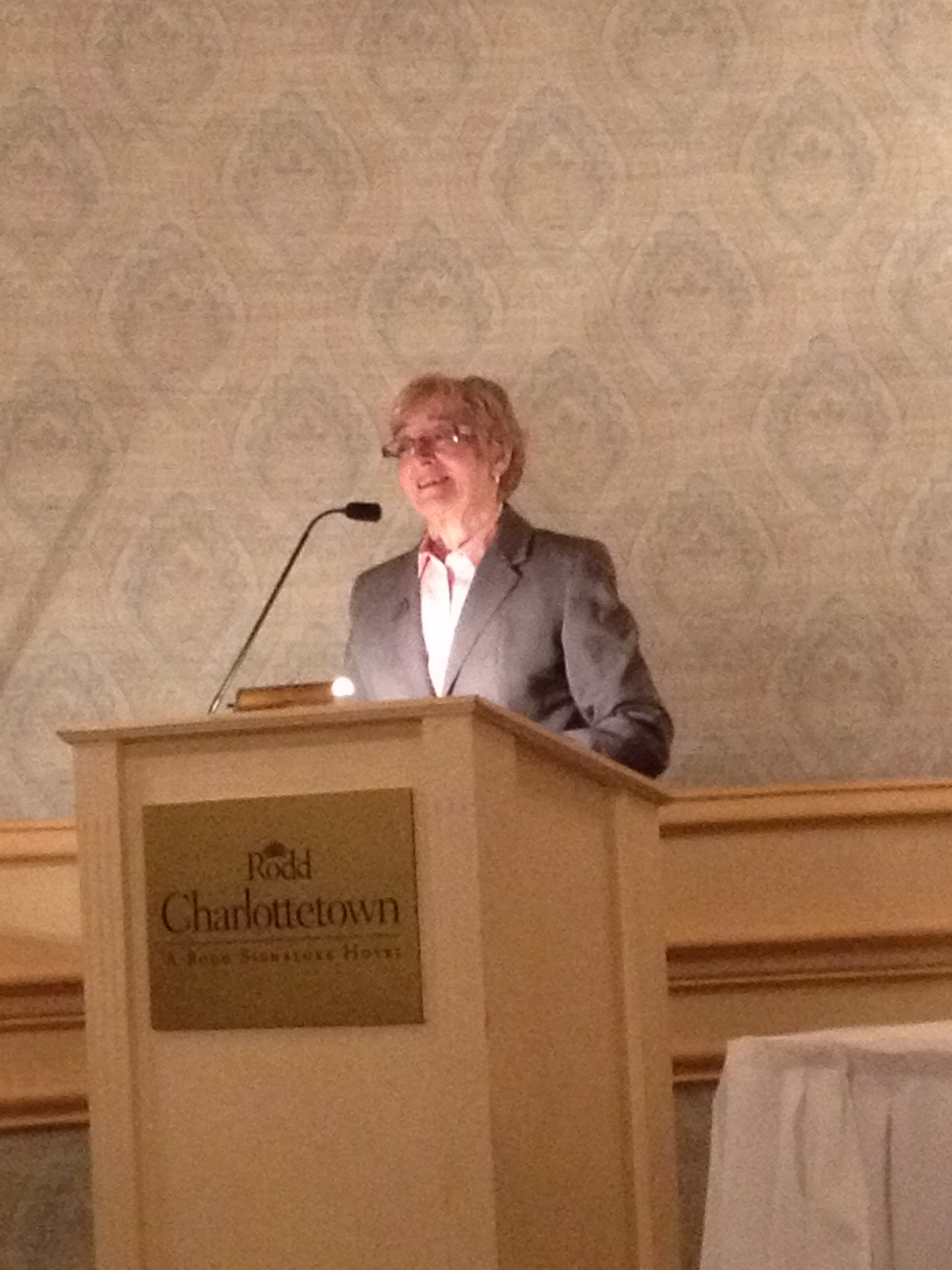
It was a packed room at the Rodd Charlottetown last night to hear Maude Barlow, Chair of the Council of Canadians, and Reg Phalen, organic farmer and member of the National Farmers’ Union, John Joe Sark, and biologist Daryl Guignion speak.  CBC reported 200 but it was actually closer to 300.

Maritime News from last night:
http://www.cbc.ca/player/News/Canada/PEI/ID/2439671882/
about 5:45 into the broadcast.

Earlier in the day, Maude spoke with the media about the issue of high capacity wells and the formation of the Coalition:
http://www.cbc.ca/player/News/Canada/PEI/ID/2439649824/
4:45 into the broadcast

Keptin John Joe Sark spoke first about the importance of water and presented an eagle feather to both Maude and to Leo Broderick.  Reg and Daryl each spoke after that (I can summarize their thoughts another day soon).

The author of several books, including the most recent Blue Future, Protecting Water for People and the Planet Forever,Maude has seen water issues in many parts of the world.  She talked about the “myth of abundance” and that “lifting the moratorium would be the worst thing that could happen to PEI.”

She said this is a “watershed moment” that can lead to a province-wide Water Act, based on a “water ethic”:
(reporting errors are my own):
1) Water is a human right — there is an obligation to prevent third party destruction of water sources.
2) Water is a public trust, with a “hierarchy of use” being made, and government as the trustee (“Don’t laugh,” she said.  “It is working in other parts of the world.”)
3) Water has rights, too — important to keep the Precautionary Principle in mind (basically, if it could cause harm, don’t do it)
4) Water can teach us how to live together.  Like other scarce resources, it can be the source of conflict, violence, war, but also turned into water being a peacemaker (she gave examples).


At the end of a long but very pleasant day, Maude Barlow, Leo Cheverie and Cindy Richards, February 26, 2014.

A huge wave of appreciation to Leo Broderick, vice chair of the Council of Canadians, who along with many volunteers made the day’s events happen.
———–

And what can people do now?:

  • attend, if you can, the Standing Committee meeting today where the Coalition for the Protection of PEI Water will present its submission calling for the moratorium to stay in place. 1:30PM (the Coalition is presenting after a committee welcome and a greeting by Keptin John Joe Sark, so probably between 1:50 and 2:30PM).  Coles Building, Richmond Street, next to Province House.
  • write a letter to your MLA List is here:  http://assembly.pe.ca/index.php3?number=1024555&lang=E
  • and send it to the papers:
  • The Guardian
    letters@theguardian.pe.ca

    The Eastern (and West Prince)Graphic
    editor@peicanada.com
    The Journal-Pioneer


Members of the Coalition

Members of the Coalition for the Protection of PEI Water to-date include:

Citizens’ Alliance of PEI

Atlantic Canada Chapter of Sierra Club

Cascumpec Watershed Association

Cooper Institute

Cornwall & Area Watershed Group

Council of Canadians

Don’t Frack PEI

Ellen’s Creek Watershed Group

Environmental Coalition of PEI

Friends of Covehead-Brackley Bay Watershed

Green Party PEI

Hunter-Clyde Watershed Group

National Farmers Union, District 1, Region 1

New Democratic Party of PEI

Pesticide Free PEI

Save Our Seas and Shores PEI

South Shore Watershed Association  (Tryon River, Westmoreland River, DeSable River, Augustine Cove and Cape Traverse, and Seven Mile Bay Watershed Associations)

Winter River – Tracadie Bay Watershed Assoc.

Over 200 individual members

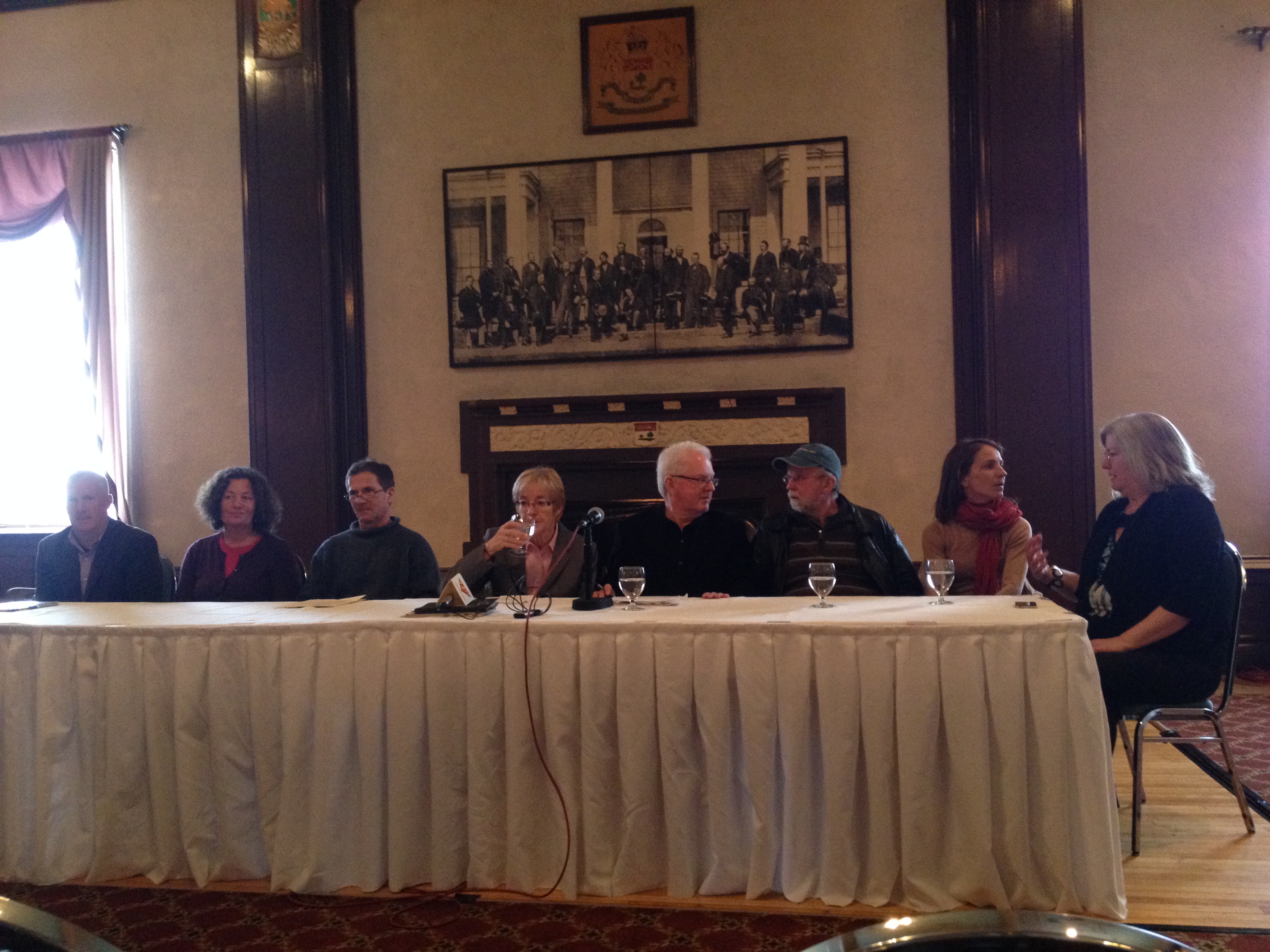
press conference with Maude Barlow, the Council of Canadians, and the CoalitionAnd the statement that will be read by Boyd Allen today at the press conference from the Coalition (with thanks for sharing that):

By mid-January, 2014, PEI residents had some time to examine the proposal to lift the moratorium on high capacity irrigation wells brought forward to Government by the processing industry and the PEI Potato Board. This became the catalyst for a groundswell of thoughtful and informed opinions which flooded an array of media across the island.

The Citizens’ Alliance of PEI sent out invitations island-wide to engage people and organizations to meet and address this issue. From this, and subsequent meetings, The Coalition for the Protection of PEI Water emerged. Our organization is composed of concerned citizens and includes The Citizens’ Alliance of PEI, the PEI Watershed Alliance, Pesticide PEI, District 1, Region 1 of the National Farmers Union, Green Party of PEI, Environmental Coalition of PEI, Don’t Frack PEI, Cooper Institute, Several Watershed Groups, Council of Canadians, New Democratic Party of PEI, Sierra Club PEI, Save Our Seas and Shores. Among the coalition members are a number of physical, natural, and social scientists. The aim of this community-based organization is to share resources, skills and time to offer an informed, unified public voice in a process in which this voice traditionally has limited access.

The Coalition for the Protection of PEI Water strongly opposes any lifting of the moratorium on new high capacity irrigation wells.

We feel that the monitoring and enforcement component attached to the existing high capacity wells is inadequate.

We feel that the data compiled to support the lifting of the moratorium is incomplete.

We recommend an opportunity for peer review of the water extraction policy, the data and the models used to support it.

We recommend the establishment and funding of a transparent, inclusive public consultation process to examine all aspects of this policy.

We recommend the establishment of a multi-disciplinary commission to develop a comprehensive, integrated water policy for PEI.

The Coalition for the Protection of PEI Water will be presenting our position on maintaining the moratorium on high capacity wells to the standing Committee of Agriculture, Environment, Energy and Forestry 1:30 pm tomorrow, Thursday 26 February at the Coles Building.

February 26th, 2014

Regarding water issues and especially the high capacity wells, there are three events happening in the next two days that you are most welcome to attend:

  • the first is a press conference with Maude Barlow, the Council of Canadians, and the Coalition today, Wednesday, February 26th, at 11AM, at the Rodd Charlottetown (Provinces Room).  Corner of Kent and Pownal in Charlottetown.  There will be people there from many of the groups on the Coalition for the Protection of PEI Water. Boyd Allen will be representing the Coalition (see statement, below), and Cindy Richards on behalf of the Citizens’ Alliance.
  • Maude Barlow (Council of Canadians Chair, and author of many books), biologist Daryl Guignion and organic farmer Reg Phalen are part of a forum on water issues tonight, 7PM, Rodd Charlottetown. It’s co-sponsored by the Council of Canadians and the Coalition for the Protection of PEI Water, and emceed by Catherine O’Brien.  Definitely be a great public event you can tell others about, if they don’t know about it already.  https://www.facebook.com/events/394497057360643/?ref=2&ref_dashboard_filter=upcoming
  • Thursday afternoon (1:30PM) is a government standing committee meeting, where the Coalition for the Protection of PEI Water will be presenting a submission. Catherine O’Brien and Boyd Allen will be representing the Coalition.  **People in the Gallery (the seating at one side of the room) really make an impact on the Committee as far as gauging public interest**, if you can be there at all, even for ten or 15 minutes.   It is in the Pope Room of the Coles Building. The Coles Building is the pretty old block building to the other side of Province House (Confed Centre on the other side).   You go up the stairs to the main floor and check in with a concierge, and go down the hall to the Pope Room, where there are chairs for the “gallery” (spectators).  We will likely be speaking at about 1:45-2PM or so for a half hour or so. (People can come and go as their schedules allow.)

And, if you live in the Brackley area, tonight is the public meeting with Minister Vessey about plans to move the “government garage” from Riverside Drive by the Civic Centre and the Wendy’s/Tim’s to a piece of land that was a 100-acre farm just outside Charlottetown city limits on Route 15.  If you want to decide for yourself if this is a good use of government money and farmland, I believe it is at the Brackley Community Centre tonight.


February 24th, 2014

More about related to calculating “recharge of aquifiers”, using swimming pools as a visible analogy.
http://www.theguardian.pe.ca/Opinion/Letter-to-editor/2014-02-20/article-3622240/Leave-pools-out-of-water-debate/1

Leave pools out of water debate
The Guardian letter to the editor
Published on February 20, 2014 

Editor:
Like most regular readers, I have been following with interest, the numerous articles and letters in The Guardian on the issue of deep-water wells. In the headline article of Fridayʼs (February 14) paper, “ No decision made on deep-water wells: Sherry,” there was an assertion attributed to Mr. Bruce Raymond (manager of watershed and subdivision planning for the province), that is worthy of pause and re-examination. Mr. Raymond is quoted, saying, that the rate at which P.E.Iʼs groundwater is replenished every year is “equal to 154 Olympic-sized swimming pools for every square inch of the Island”.
According to Wikipedia, an Olympic-sized swimming pool contains 2.5 million litres of water, with a volume of 88,0000 cubic feet. It is easy to determine that one cubic foot of water would be 144 feet in height on a single square inch of P.E.I. soil. It follows that 88,000 cubic feet would be 2,400 miles high! That is for a single Olympic-sized swimming pool. For 154 pools, this tower of water would reach an amazing 369,600 miles in height, which is 1.5 times further away than the moon. Hmm. That would be one wicked replenishment rate.
According to Island information, however, “the average yearly rainfall is 1125.8 mm and the average yearly snowfall is 318.2 mm” on Prince Edward Island. That translates to approximately 1.5 meters (or 5 feet) of precipitation per year.
Comparing 369,600 miles to 5 feet, we can determine that the Olympic-sized pool reference is out by a factor in excess of 390 million. Clearly, either Mr. Raymond was misunderstood or he misinterpreted the data. Either way, it seems clear — it would be better to simply disregard any future reference to swimming pools.
Mel Gallant,
Charlottetown

February 22nd, 2014

Despite the imperative headline given to it (it was different in the peicanada.com website as “Deep water wells risk turning ocean into salt water desert”), it is an interesting letter to contemplate:

Man should not drill into aquifer
Published on February 20, 2014 in The Guardian

Editor:
On the basis of groundwater, the sandstone of P.E.I. is considered to be composed of two zones: an upper zone, highly fractured having significant near-vertical fracturing and a lower zone, below about 35 metres, much less fractured and having few near-vertical fractures. Below the first aquitard layer the lower zone is known as the confined aquifer. An aquitard is a material like claystone and siltstone that has low permeability but transmits water at low flow rates.
The water flow in the confined aquifer is referred to as the ʻdeeper circulationʼ and is on a regional scale and not restricted to watersheds. Once the confined aquifer enters under the ocean it is called the confined submarine groundwater discharge (CSGD) aquifer. This deeper circulation through the CSGD affects directly the productivity of the ocean and has been and is being impacted in P.E.I. by human activities of the surface.
The proper jurisdiction of the confined aquifer should be the Department of Fisheries and Oceans.
The CSGD aquifer is driven by the deeper circulation of the confined aquifer on land, gravity in the end. Man should not be drilling into the confined aquifer on land and withdrawing its water. Municipal wells are not excluded. The deep water wells that have been drilled are removing water from the deep circulation and are reducing the productivity of the fisheries. We are killing the ocean. Existing deep water wells should be sealed off at where they puncture the confined aquifer. The confined aquifer should be sealed off and truly deep geological exploration wells should have casings to 300 meters at least.
We should thank the persons who had the wisdom to place a moratorium on deep water drilling in 2003. We must restore the deeper circulation; otherwise, we run the risk of turning the ocean into a saltwater desert.
Tony Lloyd,
Mount Stewart

Comments on the PEI Extraction Policy presentation

The second is enclosed in this e-mail and what was read aloud at the last meeting: comments on the PEI Extraction Policy presentation written by Dr. Scott Rice-Snow, a hydrologist at Ball State University who was an adjunct professor with the Institute of Island Studies and lived on PEI for half of last year.

<<
I've had the chance to look at some of the web postings about the high-capacity well proposal, including the Ministry of Environment PowerPoint. The 'science' presented so far is certainly limited, and I can't claim to know all regulations in place for PEI groundwater that might be escaping coverage, Here are some thoughts:

The island-wide average 7%-used statistic seems to be getting most of the press, but is basically useless for evaluation of the water extraction conditions in any one part of the island, and therefore for setting water policy for the whole. Evaluation should be at least focused to the particular watershed. The Environment presentation makes this clear, and shows that particular watersheds on the island are already overstressed.

The criteria given for water extraction, that would presumably be applied if the moratorium is lifted, are focused on maintenance of the majority of local stream base flow. They don't address other concerns, such as change in concentration of pollutants in groundwater, lowering of water levels in nearby wells, and coastal salt water intrusion in aquifers. If the island decides to allow high-capacity extraction proposals, evaluated case-by-case, it would be important to broaden the bases for refusal.

The argument "It's all (mostly) just going right back into the ground anyway" won't have any validity if water is being transported from one watershed to another. (This adds to concerns about the quality of the returned water.) Transporting irrigation water across watersheds might become a lot more common as an answer denial of local extraction permits.

Any big well will create a 'cone of depression' in the water table surface that could lower water levels in nearby wells, and possibly shift directions of groundwater (and pollutant) flows in the surrounding area. These effects should be simulated, and open to public comment, prior to a permit.

If a proposed well is in a headwaters area of a basin, it's especially important to ask for a water budget for only that part of the watershed. Even if the watershed-wide water balance fits criteria, the smaller area's groundwater levels could lower considerably, and portions of nearby streams go dry. A big well near a watershed divide can draw in groundwater from adjacent watersheds, reversing previous directions of groundwater flow. If a proposed well is far downstream, near salt water, then local salt water intrusion into the aquifer is a key concern.

Of course, the variety of problems that could occur in specific locations might be brushed over at this stage of the debate, but they do bear on what protections should be in place before a ban is lifted, and in considering the cost/benefits of lifting the ban at all.

Water resources for PEI

A Conservation Strategy for Atlantic Salmon in P.E.I.
http://atlanticsalmonfederation.org/pei/2009peireport.html

With this note: There is reference in this report to the impact of irrigation and the importance of headwaters for spawning of salmon but would apply also to brook trout.
———-

Resources from the Watershed Alliance’s Workshop on Groundwater Extraction, November 30, 2013

The Groundwater Extraction Workshop held by the PEI Watershed Alliance on November 30, 2014 allowed various groups to put forward their research and their views on groundwater extraction on Prince Edward Island. The presentations are available through the PE Watershed Alliance website:

The Water Beneath Our Feet: Understanding the Groundwater Resource (Kerry MacQuarrie) http://peiwatershedalliance.org/web/wp-content/uploads/2012/04/PEI_watershed_alliance_presentation_Nov30.pdf

A modeling tool for assessing the impacts of groundwater extractions on stream flow in PEI  (Yefang Jiang)http://peiwatershedalliance.org/web/wp-content/uploads/2012/04/modeling-impacts-by-GW-extractions-in-PEI1.pdf

Water Extraction Policy for PEI (Department of Environment, Labour & Justice) http://peiwatershedalliance.org/web/wp-content/uploads/2012/04/PEI-Water-Extraction-Policy-G-Somers-Nov-30-2013.pdf

Irrigation on PEI: The On Farm Perspective ( Innovative Farms Group) http://peiwatershedalliance.org/web/wp-content/uploads/2012/04/Irrigation-On-PEI-The-on-farm-perspective-1.0.pdf

What Supplemental Irrigation can do for the PEI Potato Industry (Cavendish Farms and the PEI Potato Board) http://peiwatershedalliance.org/web/wp-content/uploads/2012/04/cavendishHCwells2013PPTVIEW.pdf

Why Fish Need Water – Cool, Clean, Abundant Water (Daryl Guignion) http://peiwatershedalliance.org/web/wp-content/uploads/2012/04/Why-fish-need-water-November-30-2013.pdf

Understanding the Potential Impacts of Water Abstractions on Stream Ecosystems of PEI  (Allen Curry and Wendy Monk)http://peiwatershedalliance.org/web/wp-content/uploads/2012/04/pdf_Nov30_2013_PEIAbstractionWebinar.pdf

The following letters from the Watershed Alliance and watershed groups expressing concerns over the deep well ground water extraction for irrigation were forwarded to Minister Sherry after the workshop.

Letter to Minister Sherry from the PEI Watershed Alliance:
http://peiwatershedalliance.org/web/wp-content/uploads/2012/04/hcwells2013.pdf

(The Watershed Alliance received the same reply that others did)

Letter to Minister Sherry from the Central Queens Branch of the PEI Wildlife Federation:
http://peiwatershedalliance.org/web/wp-content/uploads/2014/01/Groundwater_CQWF.pdf

Letter from Prince County Chapter Trout Unlimited:
http://peiwatershedalliance.org/web/wp-content/uploads/2014/01/Groundwater_Trout_Unlimited.pdf

———-


These are notes from Steven MacKinnon’s evaluation of science references sent to him by the Department of Environment, typed up by Edith Ling, February 13, 2014 — it is also attached to this e-mail


WATER EXTRACTION PERMITTING POLICY – JANUARY 2013


P.4 –  Aquifer is recharged at a rate of 20 – 40% of annual precipitation (1100 mm).


–  Groundwater discharge to streams 60-70% of annual flow and nearly 100% in summer.


–       Island-wide groundwater extraction is 1.4% of total recharge.  In certain watersheds it is

40% of recharge.


P.5  –  Flow is least from July to end of October


P.6  –  U.K. protocol – maximum extraction of 15-35% of natural flow and 7.5-25% in

ecologically  sensitive rivers.


P.9  –  Zero impacts near headwaters are impossible under continuous groundwater pumping ….

the impact of pumping on stream flow is very challenging.


P.11  –  Permits will generally be issued in allotments of 400 or 800 igpm.  Previously only

permits for 400 igpm were issued.


Potential Impacts of Surface Water Withdrawal on Stream Ecosystems of PEI – March 31, 2006


P.4  –  In recent years, increase in potatoes, municipalities, industry & tourism ….. the relevance

of these three potential effects on stream ecosystems is unknown for P. E. I.


P. 17  –  There is a greater severity of potential impacts on physical habitats when  water levels

decline by 10 cm. during low water conditions …. Specific habitat requirements for

brook trout in P. E. I. have not yet been determined.


Understanding the Potential Impacts of Water Abstractions on Stream Ecosystems on PEI -October 1, 2008


P. 18  –  The surface water abstraction was predicted to reduce brook trout habitat up to 20% ….

But the model is provisional and requires more data to be properly validated.


P.19  –  The immediate question for P.E.I. streams arising from our studies remains “is a 20% loss             of habitat in  a P.E.I. stream biologically significant?”


Planning and Managing for Surface Water Abstraction on P.E.I. – October 1, 2009


P.1 –  Numerous studies have demonstrated that reductions in flow of streams can have

significant negative impacts on stream biota.


P.18  –  ……. however, uncertainty about impacts on ecosystem health has not yet been

overcome, i.e. there is no simple model that we can presently provide for the

appropriate environmental flow requirements of rivers.

–       how the whole population responds to multiple years of abstraction …. (acute and

sublethal effects, not yet tested)


–       It remains to be determined if these results can be applied to smaller streams.


P. 20  –  The potential cumulative effects of multiple pumping in a single stream are unknown.