Quote from Minister

George Webster, Agriculture Minister, regarding high capacity wells: “We need much more consultation with the public so they are informed.”

Once again, Consultation results in the populace being Educated.

———-

But here is the quote we need:
“Fumigation of soil, more high capacity wells, soil erosion, nitrates in ground and surface water, fish kills (better to call them river kills) and multiple, annu al anoxic events in our waterways across PEI. We have tied it all together so many times and brought it to our politicians, planners, farmers, industries, road builders and more. We will continue to do so, but we need to keep improving the awareness of the connections. Our wildlife, natural areas and our own health depend on us not making this situation worse. Do what you can to prevent future damage.”
 – Jackie Waddell, Island Nature Trust

February 1st, 2014

The concerns about lifting a ban on high capacity wells keeps pouring into our public forums.  The papers are full of excellent letters practically each day.   It would seem incredibly un-smart if a government didn’t pay attention to the tenor of public opinion as exemplified in our dear GuardianJournal-Pioneer,and Graphics.  Unfortunately, as with Plan B, government appears either not paying attention to this legitimate mode of public communication**,  or purposing downplaying people’s opinions.
**in what seemed like a bit of a Sarah Palin moment, my MLA admitted last year that she often didn’t read the paper.

Your letters definitely get the *public* thinking.

The Guardian
letters@theguardian.pe.ca

The Eastern (and West Prince) Graphic
editor@peicanada.com
The Journal-Pioneer

On last night’s CBC Compass, reporter John Jeffery went to the Federation of Agriculture annual general meeting and summarized it pretty well, with his story about 6:20 into the broadcast.
http://www.cbc.ca/player/News/Canada/PEI/ID/2434238635/
The membership heard from Bruce Raymond of the Department of the Environment who was on CBC Radio early Thursday, saying The Science says there is plenty of water if we stay within the policy.

The Department of the Environment (to their credit) Friday placed what is likely Mr. Raymond’s powerpoint presentation on this page.  The second choice has the “slides” with additional background information, and the third is the actual policy.  (Just a note that a policy is not the same as legislated “Water Act”, a related issue.)
http://www.gov.pe.ca/environment/water-extraction
If you have time to poke around in it this weekend.

The Federation did not make any sort of public statement on the issue of high capacity wells.

Agriculture Minister George Webster did say, “Don’t look at your own farm gate. Look at the Big Picture.”  A statement most would agree with.

From Rob MacLean, blueberry farmer, among other things, of Lewes:
http://www.theguardian.pe.ca/Opinion/Letter-to-editor/2014-01-29/article-3595303/No-reason-yet-to-trust-industry/1

No reason yet to trust industry
Letters to the Editor (The Guardian)
Published on January 29, 2014

Editor:
If governments and the potato industry havenʼt gotten soil conservation right, why should we believe theyʼre competent to manage our common water supply?
Science is very clear that minimizing erosion by maintaining soil organic matter of at least three percent is what we should do and that a crop rotation of at least three years is the way to do it. We canʼt plead ignorance. For decades, weʼve had commissions, round tables, teaching sessions and grants encouraging this goal.
In 2002, we even passed a law mandating crop rotations. The governmentʼs own website says one purpose of the Crop Rotation Act is “to maintain and improve ground and surface water quality . . .” So, how are we doing?
According to the Report of the Commission on the Lands Protection Act (p.28), from about 2001 to 2008 organic matter dropped Island-wide. At the start of the period, roughly two-thirds of the samples met the minimum level of three per cent. By 2008, only half were making the grade. Thatʼs not all. The same report (page 28 again) says fully one in four potato farms are not in compliance with the Crop Rotation Act. In other words, theyʼre breaking the law.
Historically, governments have been reluctant to prosecute offenders under the Crop Rotation Act. Maybe it seems like piling on to someone who already has plenty of troubles. Whatever the reason, going easy on offenders has the unintended consequence of discrediting the entire potato industry in the eyes of the public.
Learning the science of the water under our feet is just the beginning of the deep-well conversation. Our history with soil conservation proves that we have a lot to learn about putting environmental knowledge into practice. Until we do, thereʼs no reason to believe the potato industry can be trusted with our water.
Rob MacLean,
Lewes
———-

February 2nd, 2014

Some random notes, perhaps good for reading with a warm cup of something on a wet Sunday:

Fracking in Noca Scotia:
A Nova Scotia company says it is able to clean up fracking waste water.
Is this the water used to frack the well, then pumped out and in holding structures, or the water and chemicals that leaks through any breakdown in the concrete pipes?  (I think I know the answer.)
http://www.cbc.ca/news/canada/nova-scotia/fracking-waste-can-be-cleaned-for-disposal-minister-1.2518765

As of right now, Nova Scotia is not allowing fracking, but the new government has called for a review, which is evaluated here:
http://nofrac.wordpress.com/
———–

Regarding PEI and high capacity wells:
Yesterday’s Guardian had a story about the presentation on groundwater by the Department of Environment’s Bruce Raymond at the Federation of Agriculture’s AGM Friday, and Agriculture Minister Webster’s comments (article printed further down this e-mail):
http://www.theguardian.pe.ca/News/Local/2014-02-01/rticle-3599115/Deep-water-well-issue-may-go-to-public-consultation/1

Someone wrote me:
“It would appear that Government has ripped the (Educate the Public on the Wells) File back from the Potato Board.

The press did not note any Potato Board presentations at the Federation of Agriculture meeting. 
Government is now doing the Full Sale mode (including a timely little “Environmental Update” tucked into this morning’s Guardian).
It seems as though they are using the road-tested “Announce and Defend” template, sans Announcement.
Sherry has been muzzled as well, with the Premier stepping up to take the helm.
The Good News is that both Ghiz and Webster are not optimistic about getting Permits on-stream this season.
They both are talking about some form of public consultation.
This to me indicates that some Time has been bought.”

———-

Deep water well issue may go to public consultation

by Steve Sharratt
Published in The Guardian on February 1, 2014

He’s not ruling it out but Agriculture Minister George Webster says the lifting of the deep water well moratorium and issuing new permits this year could be a stretch.

But that all might depend on the opinion of Islanders.

Webster confirmed at the annual meeting of the P.E.I. Federation of Agriculture Friday in Charlottetown that a process is forthcoming to engage the general public and gather opinion on the controversial issue.

A moratorium on deep water wells was established 10 years ago and some potato growers are pressing the government to lift the ban and allow some new permits to be acquired this year. There are already 35 deep water wells grandfathered into the regulations, and Webster said there have been no adverse effects recorded from those wells.

“We need much more consultation with the public so they are informed,’’ he told The Guardian in an interview. “We will likely be told here today that there is adequate water available, but we want the public to be able to air opinion and hear the science.”

Watershed management director Bruce Raymond of the Department of Environment was one of the highlights at the farm meeting when he identified that — while every region is different — P.E.I. is mostly blessed with plenty of water and at a regular recharge rate.

“It works out to the equivalent of 154 Olympic size swimming pools for every square kilometre,’’ he told a roomful of farmers at the Confederation Centre of the Arts. “That’s about 70 times more than we currently use across the province.”

Raymond wasn’t suggesting there was so much water that irrigation permits should be handed out carte blanche, but he confirmed that the entire province only uses seven per cent (for everything) of the 35 per cent of the current water supply readily available.

The $1 billion dollar potato industry is looking to irrigate about 30,000 additional acres and estimates it would only take an additional one per cent of water. Raymond said the “math” hadn’t been finalized, but estimated that was a low ball figure.

“We use about seven per cent of the available level (top of the aquifer) so there is still quite a bit of water,’’ he said.

Webster said Stratford is currently using almost 90 per cent of its current water supply and irrigation permits would not be entertained from that region, but he confirmed there were certain parts of the province where the water was more than plentiful.

The minister said he expects full consultations with the public coming soon and before any decision is made by government.

“This year might be a stretch but I’m not ruling it out or saying it’s going to happen. Some could be doable, but not from coast to coast to coast.”

Opposition Leader Steven Myers attended the presentations on deep water wells and climate change and insisted public consultation was necessary.

“I won’t oppose a decision based on good science,’’ he said. “But there’s no need to rush on making a good decision. I’m asking the government to put everything on the table so we can all decide.”
 

January 31st, 2014

The PEI Federation of Agriculture is meeting today for its Annual General Meeting.

One of items is a presentation on groundwater and high capacity wells from someone from the Department of Environment, who has said the science supports the ability of Island groundwater to have “dozens and dozens and dozens” of high capacity wells (CBC Radio, yesterday morning after 6AM).  There is a resolution for government presumably about lifting the ban on these wells.

Here is a letter from the one of the watershed groups in Wednesday’s Guardian:
http://www.theguardian.pe.ca/Opinion/Letter-to-editor/2014-01-29/article-3595382/Why-should-we-support-request-where-resource-put-further-at-risk%3F/1

Why should we support request where resource put further at risk?
Letters to the Editor (The Guardian)
Published on January 29, 2014
Commentary by Mike Durant

The P.E.I. Potato Board and Cavendish Farms are asking that the moratorium on high-capacity groundwater extractions be lifted. Concerned citizens, scientists and the National Farmers Union have presented their own arguments against such action. We now learn that ex-politicians and ex-civil servants have been hired to lobby every MLA on the potato industryʼs behalf, moving the debate away from objective science and into the political realm.
The Central Queens Wildlife Federation feels that all Islanders should understand the facts of this important debate. We have sent this fact sheet to every MLA on future Islandersʼ behalf.
Did you know? The new Water Extraction Permitting Policy allows 100 metres of headwater streams to dry up entirely during the low-flow time of the year when groundwater makes up all or most of stream flow. As the flows are reduced, the pathway for water shrinks in from the banks of the river, further eliminating the downstream edge habitat that is so critical for young fishes and other aquatic life. Young fish forced into mid-stream are eaten by larger fish, reducing and potentially eliminating future generations of the population. Where will the fish come from to sustain these populations?
Did you know? There is a lag time for recovery of groundwater loss from extraction. It may be many weeks before the affected stream will return to normal levels. If this is very late in the summer, the water level may not recover until spring. Island rivers are already being impacted by low water levels and low rates of recharge in recent years, evident from Environment Canada monitoring. Will recharge rates return to the historical rates upon which the provincial extraction permitting policy appears to be based? How much will climate change affect recharge in future years?
Did you know? This issue is not just about the quantity of groundwater available to people and nature, it is also about the quality of that water. When wells pump water up to the surface for our use, it creates pressure underground that pulls water toward the well from the surrounding soil and rock.
On the Island, that means water from closer to the surface will be pulled down to the depth of deep-water wells. Water closer to the surface has higher concentrations of nitrate —nitrogen. It also contains other fertilizer components like phosphorus and water-soluble forms of pesticides. In the process of extracting water from greater depths, we will further contaminate our deepwater aquifer. What consequences will this have to the water discharging to our estuaries, and the frequency of anoxic events ?
Did you know? The guideline for acceptable levels of nitrate-nitrogen in drinking water is a concentration of 10 mg/L, for protection of aquatic life it is 2.9 mg/L. Nitrate concentrations indicating ʻpristineʼ water conditions on the Island are in the range of 0.5 -1.0 mg/L. Average nitrate values for the Wilmot, Dunk and Mill Rivers in 2008/2009 exceeded 7.1, 4.5 and 3.0 mg/L, high enough to produce anoxic events. When drinking water values climb, the only recourse for the well owner to reduce the nitrate concentration is to either install a reverse osmosis filtration system ($1,500) or dig a deeper well ($3,000). There are roughly 30,000 approved cottage lots on the Island. In some locations, they may be faced with two choices: dig a shallow well with high nitrate-nitrogen concentrations or dig a deeper well with saltwater intrusion. If someoneʼs well goes dry or is contaminated, will the potato industry be compensating them? How many Islanders can afford to front these costs themselves?  
Did you know? While the industry lobby is arguing that supplemental irrigation will improve potato yields and make Island growers and processors more competitive, the main advantages enjoyed by this industry in other regions are superior quality soils and longer growing seasons. Irrigation will not affect either of these factors. Soil quality monitoring by the P.E.I. Department of Agriculture and Forestry has shown that the benchmark three-year crop rotation does not prevent soil organic matter from decreasing year after year. A minimum of a four-year crop rotation with two years in forage is required to maintain organic matter in the soil. Why is organic matter important? Because it holds water! You canʼt retain water at the soil surface for plant uptake if youʼre growing your crop in sand. The potato industry has squandered their topsoil and soil organic matter for decades by operating in a manner that is not sustainable. Supplemental irrigation is not a cure for these harmful practices. If we continue in this fashion, the data shows that our soils will become inert and our groundwater unsuitable for animal or human consumption. How many more years will it really give the industry? Who will benefit in the long run from this initiative — potato producers or just the processors?
Yes, the potato industry on the Island has challenges and yes, they need to take a hard look at the long-term sustainability of their practices. But why should the public be asked to support an initiative where the longevity of the benefits to the industry are questionable and where a public resource is further put at risk?
The Island is in desperate need of strong policy on land and resource use. While the current government works on a land use policy, there is no indication that this will sufficiently protect our ground and surface waters from over-exploitation. We need a provincial water policy, similar to other provinces, which eliminates the potential for strong lobby groups with deep pockets to override what is in the best interest of Islanders.
Mike Durant is a board member of the Central Queens Wildlife Federation and West River Watershed Project.
———-
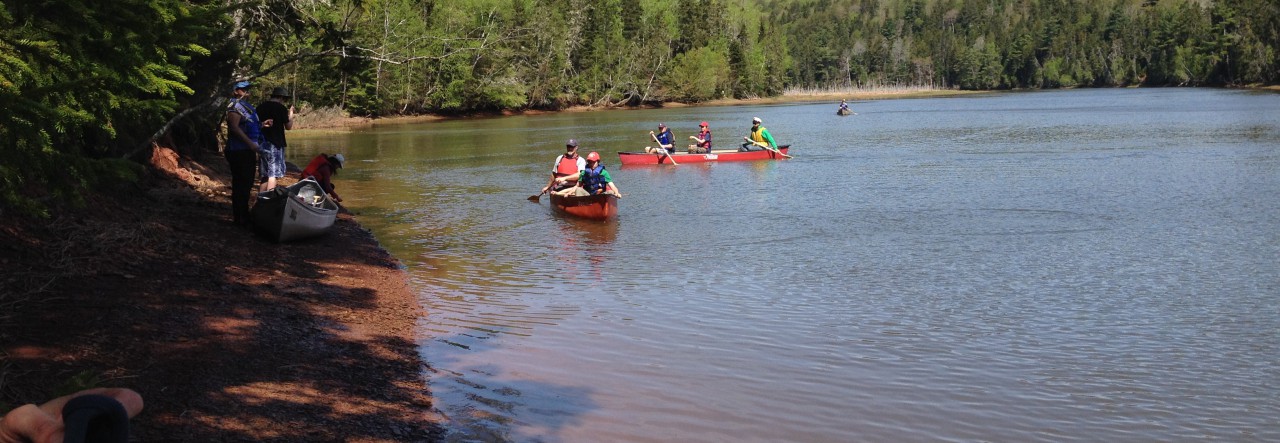
The irony is that the photo The Guardian presumably plucked from its files to illustrate the letter is from a few years back and shows the current executive director of the Federation of Agriculture flyfishing on the West River.

Ian Petrie Blog Post re: PEI Deep Well Irrigation

http://foodmatters-petrie.blogspot.ca/2014/01/a-man-on-mission.html

A Man On a Mission

I’ve always respected Daryl Guignon. He spent his working days and now his retirement teaching and advocating on behalf of the natural world.  And he’s done most of it not from the comfort of an academic’s office or university classroom,  but with hip waders on, in the cold and wet,  outside. He was always first on-site when there was a fish kill, or some other environmental crisis. He’d speak quietly but passionately about what had happened, and if asked, why. He’d never condemn farmers as a group, and would often acknowledge that many farmers are doing a better job protecting the environment.  Now he’s become the principal opponent to issuing new permits for deep water wells, and he’s definitely making headway. 

On Tuesday Environment minister Janice Sherry threw the issue back to the Potato Board, saying it has to convince the public that the science is sound, and irrigation can be done with minimal environmental impact. That followed revelations that the Board and Cavendish Farms had hired two former Liberal insiders (Chris Leclair and Cynthia King) to lobby MLA’s (the Liberal caucus essentially) about the merits of the plan.  Both of these developments indicate a proposal that’s in deep trouble.  Asking the Potato Board to convince skeptical Islanders is like asking Don Cherry to convince people sick of hockey violence to start liking it, it ain’t going to happen. In my opinion the Board has taken on an advocacy role in this not because all of its grower members want it but  because the public would be even more hostile if it were just Irving owned Cavendish Farms making the case.

And let’s be honest, Cavendish Farms does have a case to make. All its major competitors in the french fry racket work with growers who have access to irrigation. Cavendish itself operates a plant in Jamestown North Dakota and  buys from growers there who use irrigation, so the company knows the benefits. It also knows what can happen if there is a serious drought on PEI. In 2001 Cavendish had to import millions of pounds of potatoes from Maine and Manitoba to keep its big customer Wendy’s happy with french fries that droop over the front of the box (that takes big brick-like potatoes).  That’s when it started lobbying the provincial government to increase the use of irrigation here. Climate change, and the worry that sufficient rain can longer be counted on, has made this more critical.  Again let’s be honest, the real benefits of irrigation go to Cavendish too.  Unless we have several drought years in a row, the economics for potato growers investing in irrigation is very marginal.  And many growers worry that if new permits are allowed Cavendish will make having irrigation a condition of getting a contract, and that will be too expensive for growers with small contracts.

Daryl Guignon and others have also made important arguments against the plan. Much of the science on groundwater, including the limits to how much water and flow a stream can lose and still maintain aquatic life, comes from other places.  That’s not to say the science is wrong, but this isn’t dryland farming with huge sections of land devoted exclusively to agriculture. There’s hardly a watershed here that doesn’t have to support businesses, people’s homes, and wildlife, and there’s a strong feeling that despite the jobs and farm income that comes from producing french fries, one can’t take precedence over the other.

And Guignon is especially insistent that irrigation can’t be used to make up for poor soil quality. Healthy soils with adequate organic matter absorb rain and hold it for dry periods. Beat up soils that are hard packed cause rain to run-off somewhere else, usually ditches and low points in fields,  taking much needed moisture and soil particles along with it.

And there’s no question that the potato industry is guilty until proven innocent when it comes to environmental promises.   Fishkills, nitrates in groundwater, dead zones in rivers,  don’t generate  a lot of confidence. It may be the sins of the few causing the punishment of the many,  but that’s just the way it is, and no amount of lobbying or political arm twisting is going to change that.

National Farmers Union News Release

NEWS RELEASE

January 23, 2014

The National Farmers Union in this Province is strongly urging all Islanders to become involved in the discussion centering around the request by the Potato Board to lift the moratorium on drilling more high capacity wells in P. E. I.    Islanders are encouraged to contact their MLA on this matter.

Since groundwater is a precious resource, vital to all Islanders, the National Farmers Union is requesting the Provincial Government to hold public meetings on the subject of drilling more high capacity wells.  In this way, all Island citizens can be involved in the debate similar to the way they took part in the public meetings on land issues within the last year.

The Potato Board states that irrigation is needed in order for the Island potato industry to compete with growers in Idaho and other American states.  It is virtually impossible to compete yield-wise with these growers where the topsoil is so much deeper than P. E. I. and where the growing season is much longer.

The NFU suggests there are other ways to improve the moisture-holding capacity of Island soils such as improving the organic matter of the soil, using better crop rotations, etc. Enhancing our livestock industry in order to have manure to fertilizer the soil would go a long way to improving soil conditions.  All of this can be done without compromising the quality and quantity of our groundwater.  It would be more prudent to work toward developing a marketing system whereby farmers receive their cost of production instead of risking our groundwater supply.  

This moratorium has been in place for many years, and there is no good reason to lift it now.

– 30 –

Contact:   Steven MacKinnon, telephone 675-3426

January 30th, 2014

The high capacity wells issue continues:
I heard the Manager of Watershed and Subdivision Planning from the Department of Environment on CBC Radio earlier this morning.  He said the Island could handle “dozens and dozens and dozens” of high capacity wells.

From Betty Howatt of Tryon, a paragon of common sense and care of the land (bold is mine):
http://www.theguardian.pe.ca/Opinion/Letter-to-editor/2014-01-29/article-3595317/Deep-wells%2C-fracking-draw-heritage-farm-ire/1

Deep wells, fracking draw heritage farm ire
Letters to the Editor (The Guardian)
Published on January 29, 2014
Editor:
Since cultivation began on our land around the 1770s, shallow hand-dug wells have provided all needs of man and beast. There was ample water here. I can still show the location of three wells, for watering animals, now not needed, so filled in. A fourth, producing one on our property across the road from us ran dry so a new well was drilled about five years ago.
In 2013 the shallow, hand-dug well that has supplied the needs of our farm and household for the many years Iʼve been fortunate to live here, that well dried up, with another 150- foot well needed.
The farm federation does not speak for this member family. We strongly oppose the granting of permits for deep wells. We also request a permanent moratorium on permits for fracking.
An oversized sandbar, surrounded by salt water, that is our Island, our living space. Think on that.
Betty Howatt, 
Howattʼs Fruit Farm, Tryon
———-

CBC Radio is also talking to a representative from the P.E.I. Potato Board, and from Todd Dupuis from the Atlantic Salmon Federation after the 7AM news, I believe.  His very well thought-out commentary was also in yesterday’s paper (full text at end):
http://www.theguardian.pe.ca/Opinion/Letter-to-editor/2014-01-29/article-3595333/P.E.I.-potato-industry%26rsquo%3Bs-grab-for-more-water-doesn%26rsquo%3Bt-pass-smell-test/1

———-
The political panel will also discuss the issue after 7:40AM on the radio.  Presumably they’ll comment on how Environment Minister Sherry has handled this, as Paul MacNeill has written in The Eastern Graphic:
http://peicanada.com/second_opinion_paul_macneill_publisher/columns_opinions/janice_sherry%E2%80%99s_environmental_gong_show

———–
P.E.I. potato industryʼs grab for more water doesnʼt pass smell test
Commentary (The Guardian)
Published on January 29, 2014
By Todd Dupuis 

When it comes to the economy, the P.E.I. potato industry may be a giver; but when it comes to the environment, it is a taker and a big one at that. Donʼt forget that this industry is responsible for millions of tons of topsoil eroding from fields and into our waterways annually. This is the same industry that is responsible for the stinking dead zone anoxic events that happen annually in our estuaries. Itʼs the industry that is responsible for more than 40 pesticide-related fish kills, which happen like clockwork every year, some making national and international news. The industry is responsible for nitrate contamination of our drinking water, an issue that is only getting worse. Every person that drinks water out of his or her tap in Charlottetown is drinking chemical fertilizer.
Thanks to the potato industry, Charlottetownʼs drinking water nitrate level is three to seven times higher (depending on the government data you use) than what is considered normal background level. Remember the cityʼs water supply is in the countryside amidst potato fields. Many people living near the central and western potato belts would give their eye teeth for Charlottetownʼs drinking water, because their water is that much more contaminated. And while the potato industry is the cause of all these environmental issues, it takes no responsibility for cleaning it up. The industry does not have to consider the cost to the environment in its cost of doing business because it is allowed to freely impact the environment. If the industry were required to put the infrastructure in place to protect the environment, it certainly would not be worth 1 billion dollars.
It is no secret that Island soils are degraded from years of industrial potato production. Short rotations and high erosion rates have resulted in shallow topsoil with lower organic matter — not good conditions if you want to hold moisture in the soil. The fact is that our soils are in worse shape today than they were decades ago and there is little indication this trend will change soon. Big industry knows this. The problem is that once it is no longer viable to grow potatoes in the province because of degraded soils, this big industry will move on.
Remember — there is plenty of room to grow potatoes in Idaho and Manitoba. I can hear the industryʼs swan song now: “Thanks for your soil and water but we must be moving on. Sorry for your troubles.” I do not blame the individual farmer.
Like most Islanders, I have friends and acquaintances that are good farmers who are doing their best to be good stewards of the land. Most of them are independent and making their own decisions but, in many cases, the big corporations run the show. The growing of processing potatoes on P.E.I. can be tricky business for our farmers. It goes something like this: “Sign here please. Oh yeah youʼll need to grow what we tell you. You need to add this much fertilizer and by the way youʼll need to buy it all from us. Do what we tell you or else we donʼt buy your product.”
Now big Industry is making a push for more water. A well-orchestrated and well-funded campaign that has come out of the blue is designed to catch Islanders off guard. Thereʼs a new water extraction permitting policy written by a few people in government, seemingly with plenty of industry input. They say they used good science and that P.E.I. has a lot of water. They did not consult with the public though.
Iʼve read the new policy and, although Iʼm not a hydrologist, I do have some training in the field and 30 years of experience walking along and trying to protect Island streams and their fish. While the new policy states there is lots of water, I have lots of questions, as do many others in the conservation field.
I know governments are under pressure from big industry, but this government should not jump into deep-well irrigation until itʼs sure it has consulted with all Islanders and that their best interest is being protected. This government should ensure it is not leaving a legacy of dried-up rivers and contaminated drinking water. If industry and government are so confident in their water data and new water extraction policy, then the government should set up a standing committee so the public will have time to study the science and provide input. Why not let outside experts take a look at it? Why the rush? Remember — this is a new policy that has the potential to impact all Islanders, a policy that has had zero public input. If the science is as sound as industry contends, then let it stand the test. At the moment though, many in P.E.I. think something stinks. It smells like big industry is in the room.
Todd Dupuis is executive director, regional programs for the Atlantic Salmon Federation.

January 29th, 2014

Yesterday, The Guardian‘s editorial praised Saturday’s “rational” letter by the P.E.I. Potato Board chairman for not wanting “unfettered” access to water, among other things.  The editorial describes the negative reactions of those who do not want these high capacity wells, and says the Federation of Agriculture (set on Friday to pass a resolution presumably supporting lifting of the ban) is worried about Islanders getting “misinformation,” and the editorial ends with, “The key word here is misinformation.”  The editors do not elaborate on who is spreading misinformation or what the misinformation is.  Perhaps they too are wishing for more education from the Potato Board as with Saturday’s “first lesson.”
http://www.theguardian.pe.ca/Opinion/Editorials/2014-01-28/article-3593632/Ag-federation-faces-decision-on-deep-wells/1
(copied below)

Cathy Grant certainly spells it out clearly with accurate information:
http://www.theguardian.pe.ca/Opinion/Letter-to-editor/2014-01-28/article-3593578/Sherry-tips-her-hand-on-deep-water-wells%3F/1

Sherry tips her hand on deep-water wells?
Letters to the Editor (The Guardian)
Published on January 28, 2014

Editor:
Environment Minister Janice Sherry has just made a stand on deep-water well irrigation for potatoes on P.E.I. She has stated that the “P.E.I. Potato Board has to go the next step and ʻeducateʼ Islanders about deep water well irrigation.”  What the heck?
Since when does the environment minister of any jurisdiction, banana republic or potato republic, cede the “next step” to industries who will benefit from said deep-water drilling and make them responsible for ʻpublic education?ʼ
Oh yes, we have had a lot of ʻpublic educationʼ over the past several years from the government. They have informed us that decisions regarding Plan B and the HST were not popular decisions but they were right decisions according to Premier Robert Ghiz, his caucus, and the business community.
On the matter of deep-well water drilling, Ms. Sherry has previously stated she has “read all the science.”  Well I hope she will come out to share the science she has read with Islanders and not fob off another environmental disaster on an Island industry that has much to gain from Ms. Sherryʼs shrugging off her responsibility to Prince Edward Islanders and its fragile environment.
I come from a mostly Irish heritage, and though my family didnʼt settle on P.E.I. because of the potato famine, many Island families did. These statements from Minister Sherry cannot but make me think of like decisions made by English lairds when they let local Irish farmers and citizens starve rather than helping to support them and their efforts to establish more diverse agricultural practices.
Cathy Grant,
Meadowbank

Ag federation faces decision on deep wells
Editorial in The Guardian
Published on January 28, 2014

Meeting this week should signal support for potato boardʼs contentious request
This weekʼs annual meeting of the P.E.I. Federation of Agriculture will attract more interest than usual because of the contentious issue of deep-water wells for potato irrigation. The federation has wells placed prominently on the agenda with a presentation outlining the P.E.I. Department of Environmentʼs perspective on water quantity and seasonal demands, while outlining the governmentʼs water extraction policy for groundwater and surface water.
The federation will also hear an update on the Georgetown Conference and the impact of the harmonized sales tax. The federation strongly supported the HST and said tax rebates on the cost of doing business would position Island farmers on an equal footing with the rest of the region. But the key topic Friday in Charlottetown will be wells.
Deep-water wells have drawn a flood of comment because it affects every Islander who has legitimate concerns over a secure supply of drinking water and contamination of the water table with nitrates and pesticides. Itʼs a hot-button topic that leaves government with a very difficult decision. The total economic wealth associated with close to 90,000 acres of spuds is in excess of $1 billion and that money finds its way into every Island home and business.
Environment Minister Janice Sherry has received an advisory board recommendation on deep wells but is reluctant to make that public, at least at this time. She had suggested to the P.E.I. Potato Board that since itʼs their idea to lift the moratorium, it should present its arguments in a public forum to allay the concerns of Islanders.
The board issued its argument Saturday in the form of a rational, well-crafted opinion piece to The Guardian. Its key argument was science supports a reasonable, supplemental irrigation program because all demands of water in the province today “use less than two per cent of the annual groundwater recharge.” The board isnʼt seeking unfettered approval and notes that applications would be judged by the department while considering local water sources and supply. Already, there is strong reaction to chairman Gary Linkletterʼs opinion piece, all of it negative.
The National Farmers Union has made its position known, and as expected, is vehemently against the idea. The NFU is left of centre on most environmental issues and had vigorously opposed changes to the limits on land ownership last year. The federation usually leans right of centre, and had supported the increased acreage limits. The federation is usually more concerned with the bottom line for farmers, with the belief that a farmer losing money is a farmer leaving agriculture. But it does endorse the mantra of farmers being economically viable, environmentally sound and socially responsible.
The federation has yet to take a public stance on the well issue. And government is surely waiting for the farm group to signal its support or opposition before going any further. Itʼs likely there will be public hearings but a decision must be made soon to have any impact on this growing season. Potato farmers would have to dig wells, buy expensive irrigation equipment and be ready for any dry weather to assist their valuable crop. It would take months to take advantage of any change to the moratorium.
It would be a surprise if the federation doesnʼt support the potato board Friday and pass a resolution recommending the lifting of the moratorium, at least in some regulated form. A release from the board on the annual meeting already signals that position. It states there has been a lot of recent “controversy and misinformation” being circulated surrounding deep-water wells and water quality on P.E.I. The key word here is misinformation.